Photogaleries

G6 RHINO 155mm self-propelled howitzer gallery 1
gv636
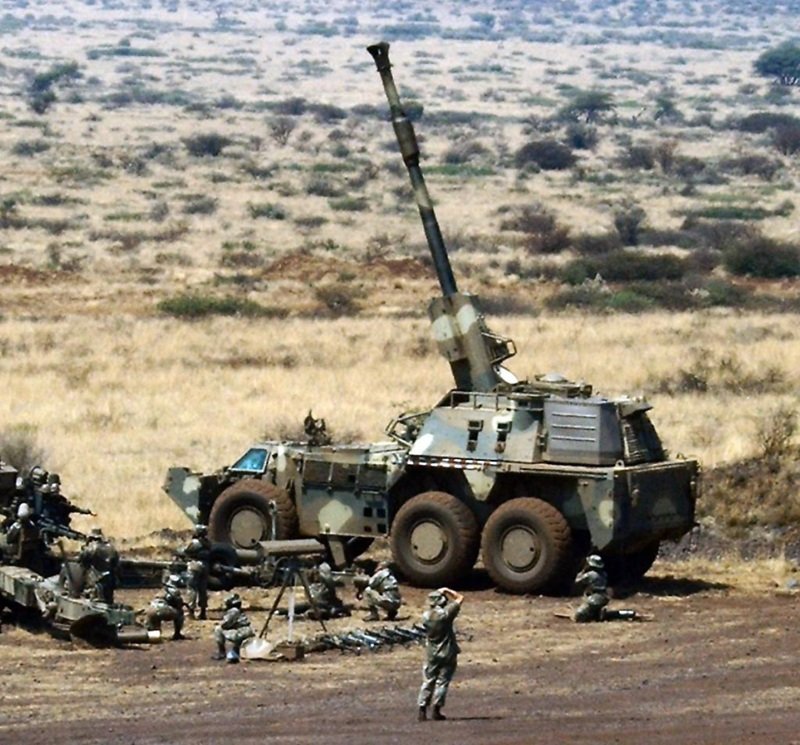
(G5 and GV6 image). The shortcomings of the SADF’s artillery had become evident during clashes with Angolan Forces in the South African Border War, so in 1973, a decision was made to modernize the SADF’s artillery, and in 1982, a 155mm towed howitzer designated “G5-45” was introduced. This howitzer was a South African development of the controversial GC-45 high performance howitzer designed by the equally controversial Canadian engineer Gerald Bull. Logically, it was decided to integrate this howitzer into a newly designed vehicle, and the work was entrusted to ARMSCOR under the name “Project Zenula”.
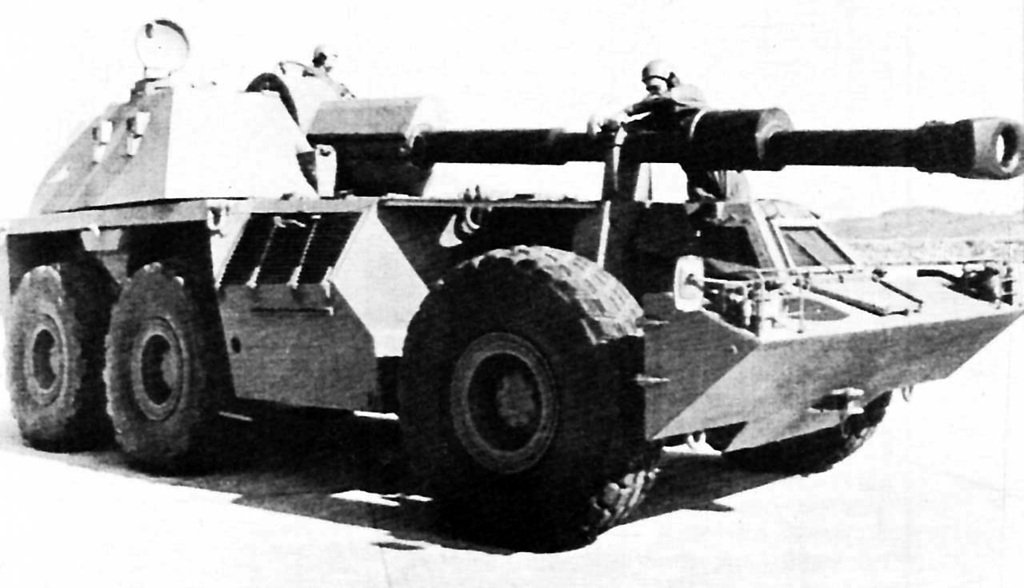
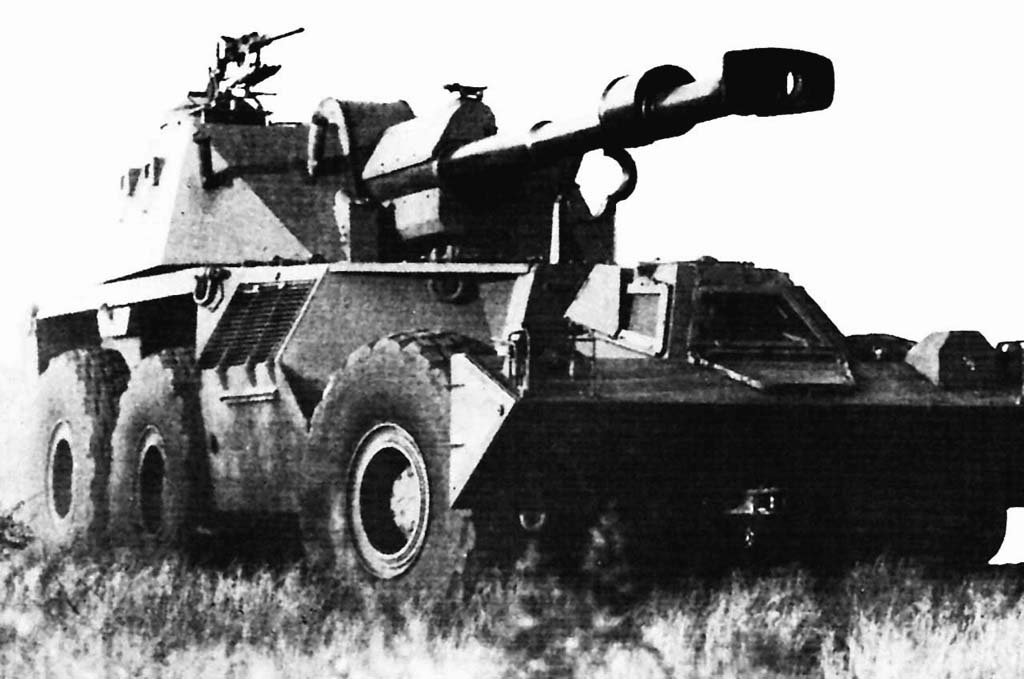
g6proto
(G6 prototype image). The development and manufacture of the new self-propelled howitzer would be handled entirely by South African companies due to the international embargo imposed on South Africa for its apartheid policies, as has happened with other systems such as the Rooikat scout vehicle or the Rooivalk attack helicopter. Sandock Austral would design the chassis, Ermatek would develop the turret, and ESD would integrate the G5-45 howitzer’s fire control system into the new vehicle’s turret. Reumech OMC would manufacture the chassis, Lyttelton Engineering Works (LIW) would produce the turret, and Naschem would manufacture the ammunition subsystems.
g6459
(G6-45 image). The South African military chose a wheeled chassis because they required a vehicle with high strategic mobility, capable of traveling long distances under their own power, without the need for tank transporters or trains for deployment far from their base, even if this means traveling several hundred kilometers. Furthermore, they require significantly less engine power, are much more economical to operate, consume up to 60% less fuel, and maintenance intervals can be two to three times longer than for tracked vehicles. On the other hand, the technical complexity of wheeled vehicles of such size and weight can be very complicated and difficult to solve.
g6456
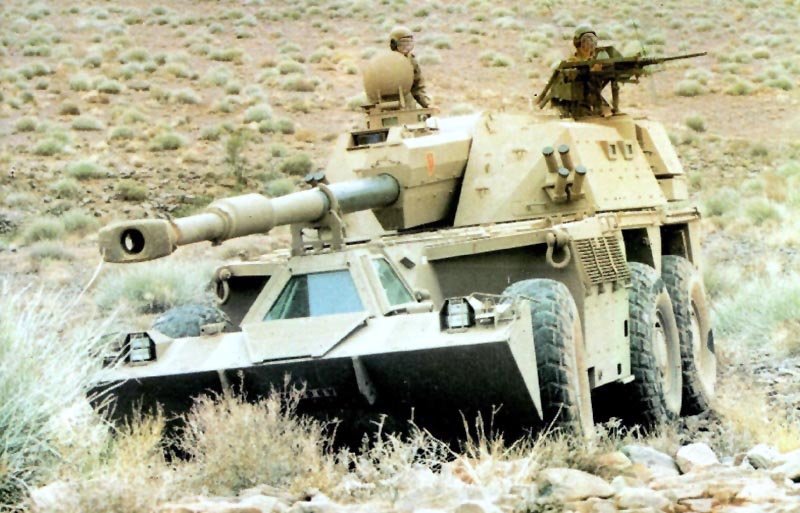
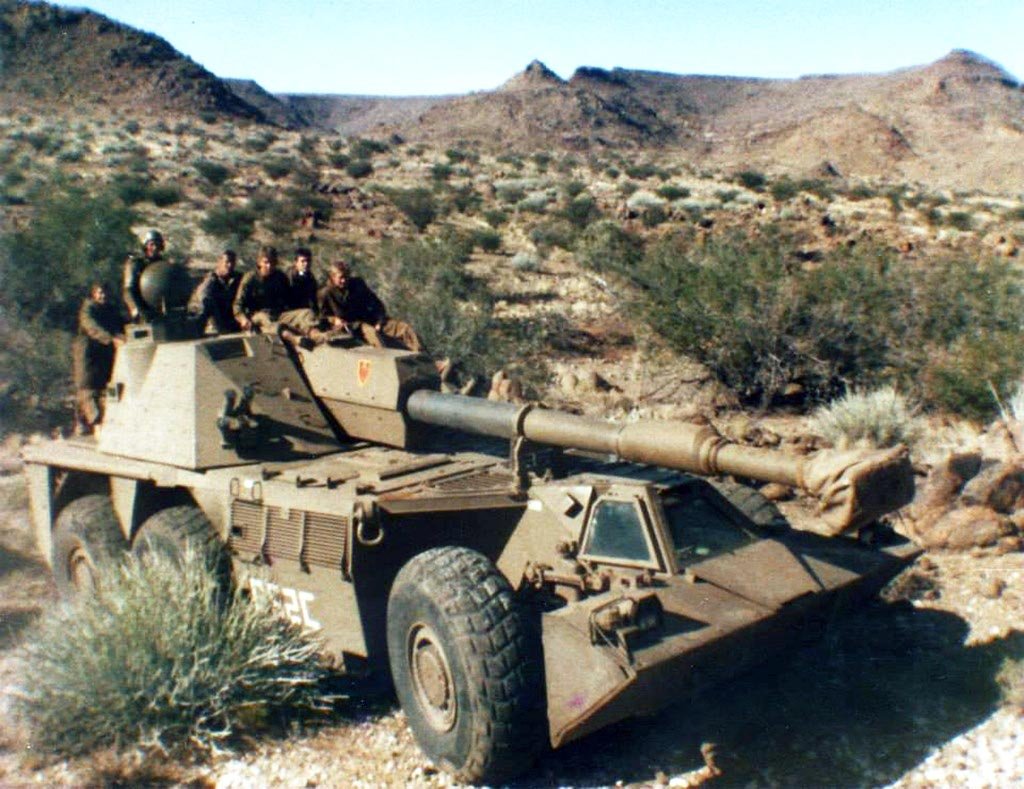
(G6-45 image). The first complete prototype was unveiled in 1981 under the designation “G6-45”, although it was also called “G6 Renoster”. Four pre-production vehicles were manufactured until 1987, which were immediately deployed to the South African Border War to test their operational performance and finalize their development, including any necessary modifications. They remained deployed there until December, when they returned to South Africa. Series production then commenced in 1988 and continued until 1994.
g64512
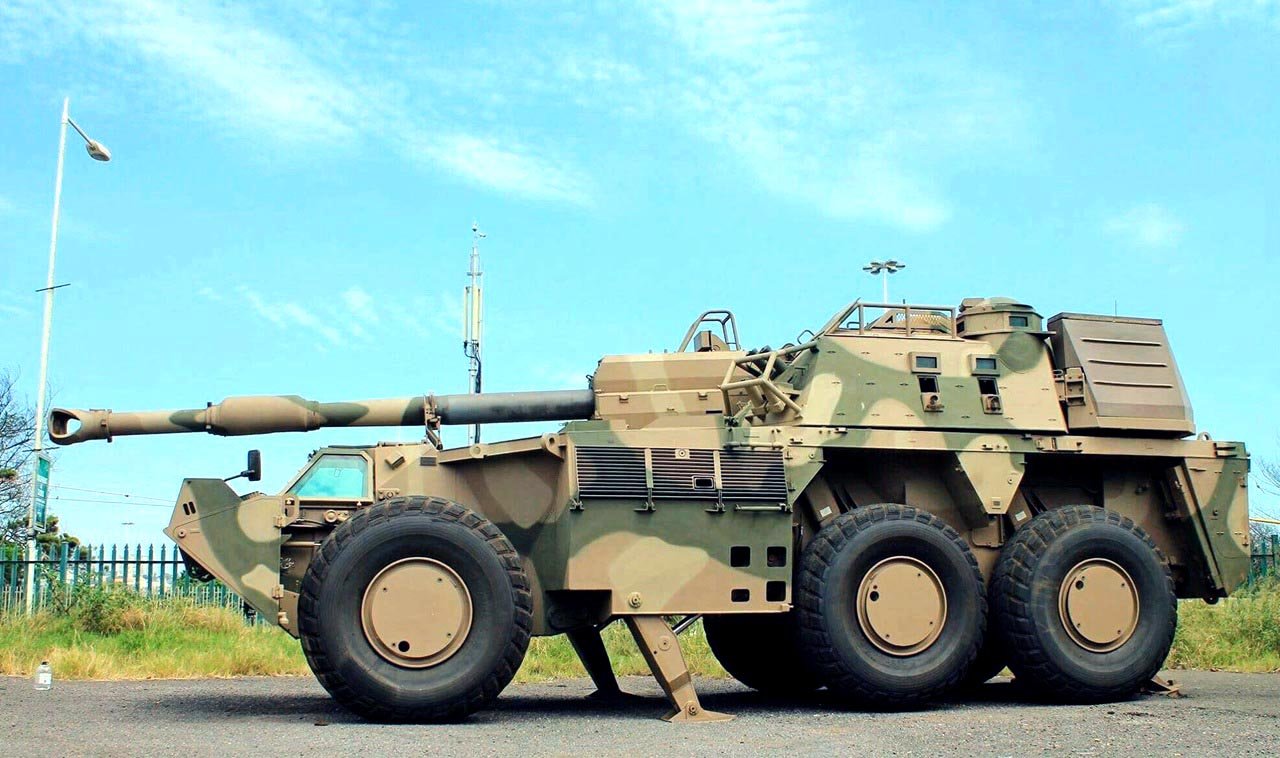
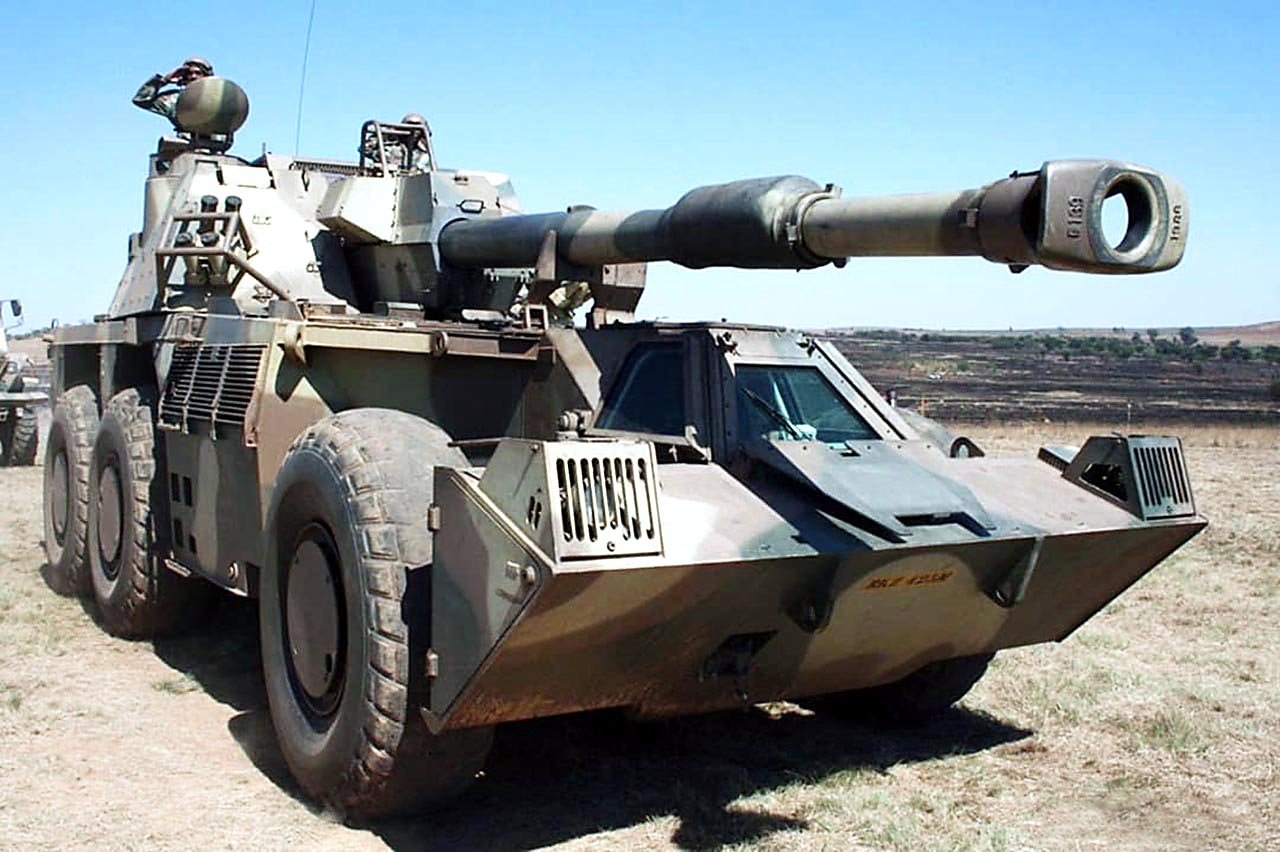
(G6-45 image). The G6‘s 6×6 wheeled chassis has one front axle and two rear axles and is fitted with large 21.00 x 25-inch industrial radial tires with run-flat elements. It features a central tire inflation system to adjust tire pressure to the terrain while in motion and can operate with multiple damaged tires. The vehicle has an independent suspension with torsion bars and hydraulic shock absorbers at each wheel. The G6 Rhino has 4 retractable hydraulic stabilizers, two on the sides under the engine compartment and two at the rear between the wheels of the third axle, which are lowered before firing.
g64510
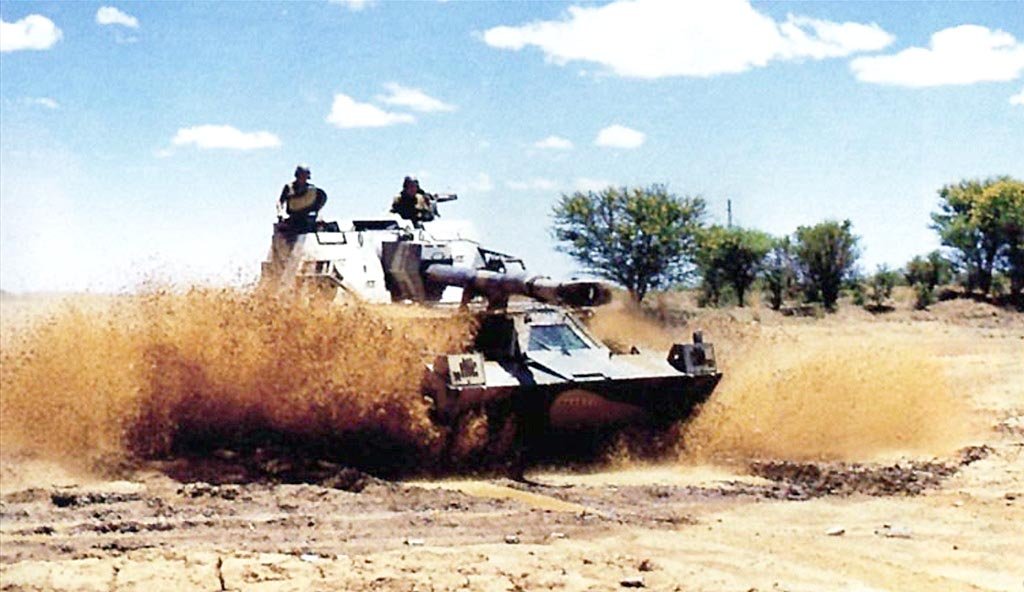
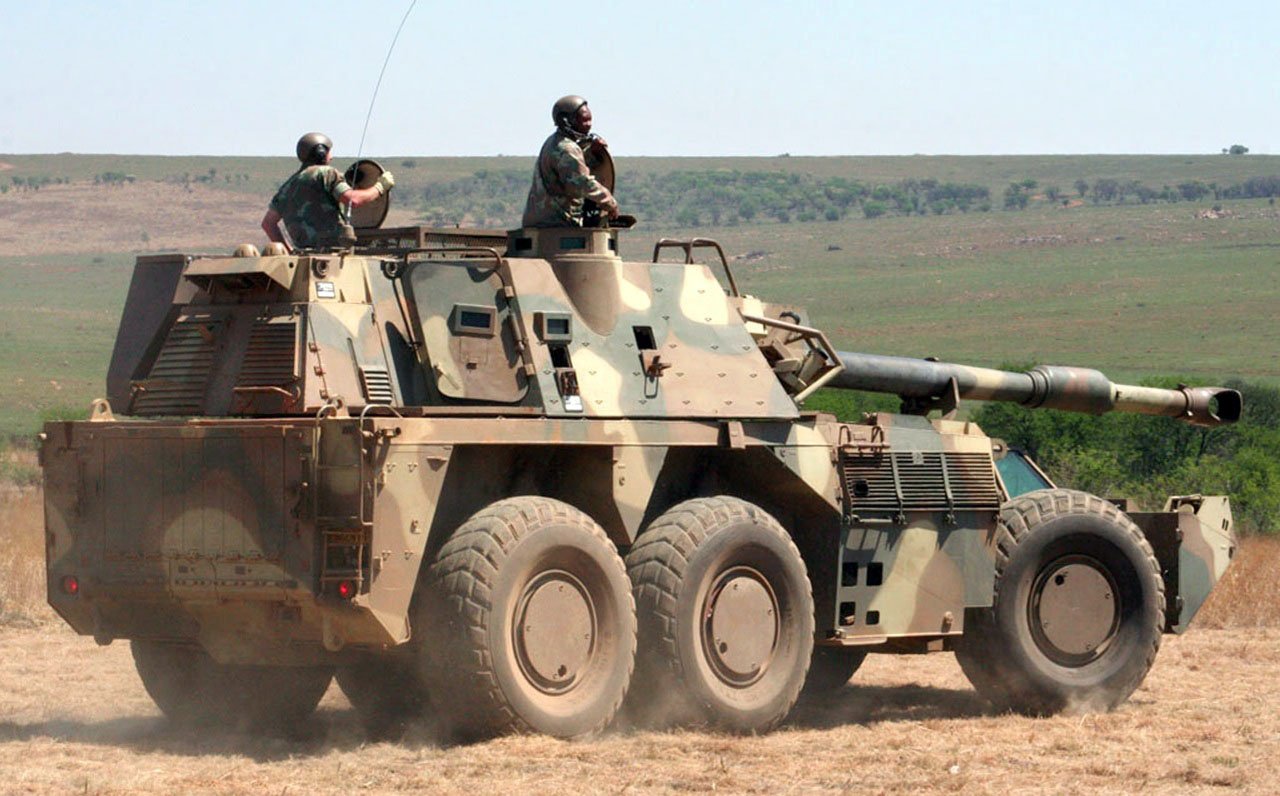
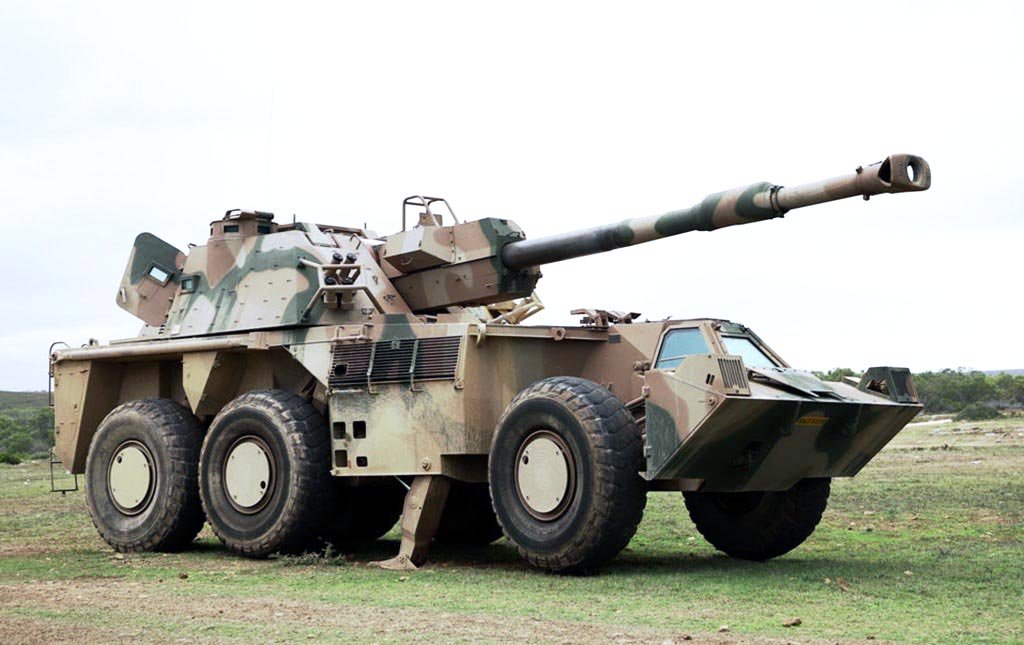
(G6-45 image). The engine is located in an unusual position, behind the driver’s compartment just in front of the turret, and it is a 550 hp Magirus Deutz BF12L513 FC V12 or a 525 hp Magirus Deutz FL 413 F/FR air-cooled diesel engines that gives it a top speed of over 100 km/h on roads. The G6 has a 705-liter fuel tank, providing a range of approximately 700 km on the road or about 350 km off-road. It can cross trenches 1 meter wide, ford watercourses 1 meter deep, overcoming vertical obstacles of 52 cm and traverse gradients of 42%, which is quite impressive for a wheeled vehicle weighing over 46 tons. It has a RENK automatic transmission with six forward and two reverse gears, with driver-selectable automatic and semi-automatic modes. It also has an auxiliary power unit (APU) at the rear of the turret to power some of the vehicle’s systems.
g6452
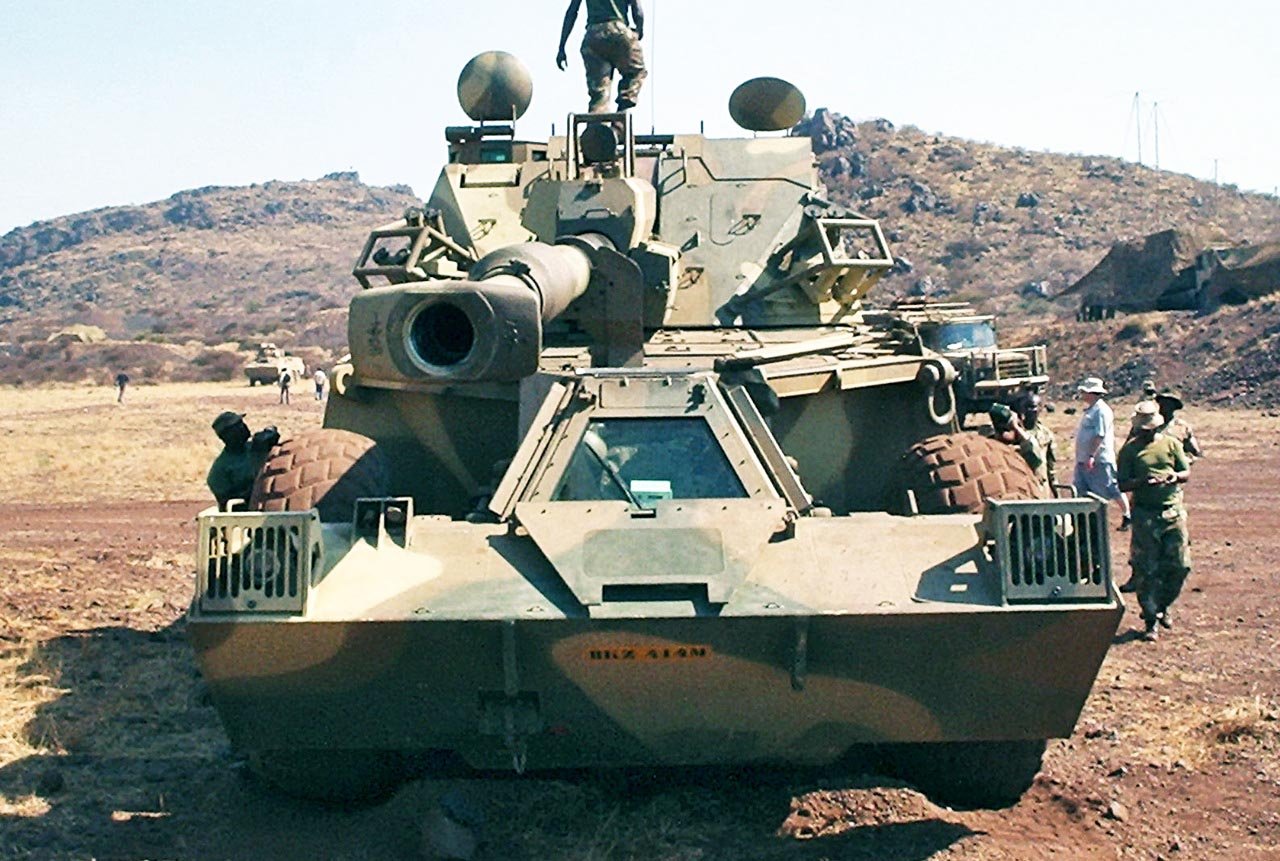
The G6-45 self-propelled howitzer (on the image) has a crew of six: driver, commander, breech operator, gun layer/navigator, ammunition handler, and ammunition loader, who have a radio intercom system integrated into their helmets. The vehicle’s internal layout consists of three compartments: the driver’s compartment at the front, the engine compartment in the center, and the turret at the rear. The driver sits in the center of the front of the vehicle and has three bulletproof windows providing excellent visibility. The central window has a mechanically folding armored plate. Access to the vehicle is via a hatch located in the roof directly above the seat. It is equipped with a periscope for daytime operations, (used when the armored plate is raised), and a passive night vision device.
gv617
(GV6 image). The turret is controlled by an electro-hydraulic system, houses five members of the crew and features several vision blocks and five firing ports. Access to the turret is via a door located on the right side and two hatches located in the roof. The commander and breech operator are located to the right of the howitzer, and the layer and loader to the left. During combat, the driver and ammunition handler remain at the rear of the vehicle and are responsible for preparing the projectiles and transferring them to the loader, who then loads them into the howitzer’s chamber. The commander has controls for driving the vehicle if necessary and a cupola with 360° vision.
gv610
(GV6 image). The G6 Rhino is constructed of all-welded steel alloy armour and it withstands small arms fire and shell splinters, although the frontal arc and the entire turret can withstand impacts from 23mm armor-piercing ammunition. The hull floor is double-layered and designed to deflect landmine blasts to the sides, protecting the driver from TM-46 landmines or equivalent to 6 kg of TNT. It also features an explosion detection and halon or NAF SIII gas fire suppression system in both the crew and engine compartments. The rear of the hull, where ammunition is stored, is equipped with blowout panels that direct the force of the blast outwards in the event of an impact and there is an emergency escape hatch for the crew in the floor of the hull.
gv615
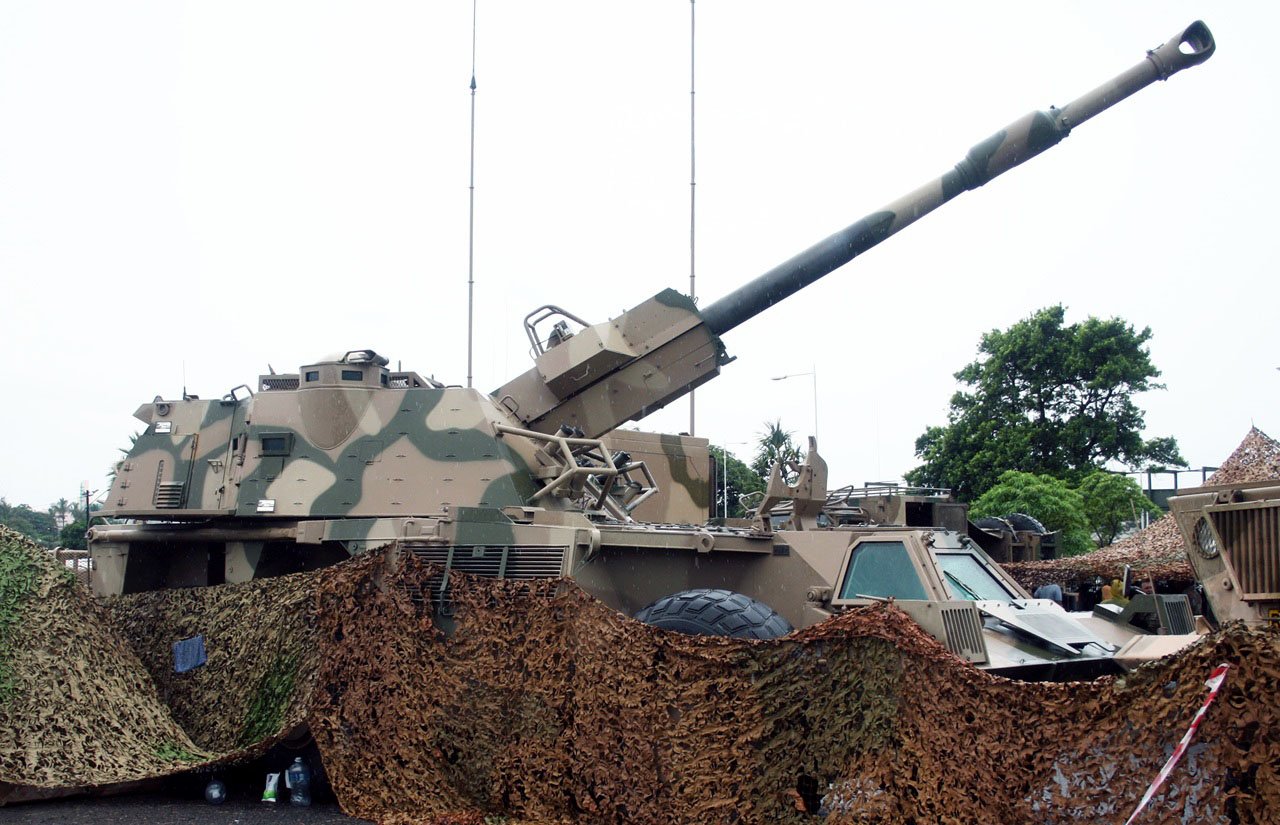
(GV6 image). The main armament of the G6 is a rifled 155/45mm autofrettaged howitzer with a 23-liter powder chamber, giving it a longer range than many other howitzers, which typically have a 21-liter chamber. The barrel has a single-baffle muzzle brake, a smoke extractor and a hydro-pneumatic recoil system with a single buffer and single recuperator. The swing breech mechanism features a semi-automatic interrupted screw-stepped-thread. The howitzer’s firing system is electric and can fire at an elevation angle of -5° to +75°, and although the turret can traversed through 180° (90° left and right), the firing arc is 40° to the right or left of the longitudinal axis. The howitzer is moved by electro-hydraulic servo control, although there is an emergency manual hydraulic system that allows the barrel to be raised and traversed.
gv638
(GV6 image). The automatic gun laying capability for elevation and traverse allows the howitzer to be aimed quickly and accurately, improving the rate of fire. These operations are easily performed using a touchscreen display once the target data is shown. The maximum rate of fire is 4 rounds per minute with maximum charge, and can be maintained for a maximum of 15 minutes. It can also reach 5 rpm with charge 2 and fire 3 rounds in 25 seconds if necessary. The howitzer’s service life is estimated at 6,000 shots with standard rounds.
gv618
(GV6 image). The howitzer has safety interlocks to prevent accidental firing, so firing can only occur once the commander, breech operator, and gun layer have disengaged their safeties. The secondary armament consists of a 7.62 or 12.7mm machine gun in a pintle mount located in front of the loader hatch and the ammunition carried is 2,000 rounds of 7.62mm or 1,000 rounds of 12.7mm. It also has two banks of four 81mm electrically operated smoke grenade dischargers installed on both sides of the front of the turret.
gv623
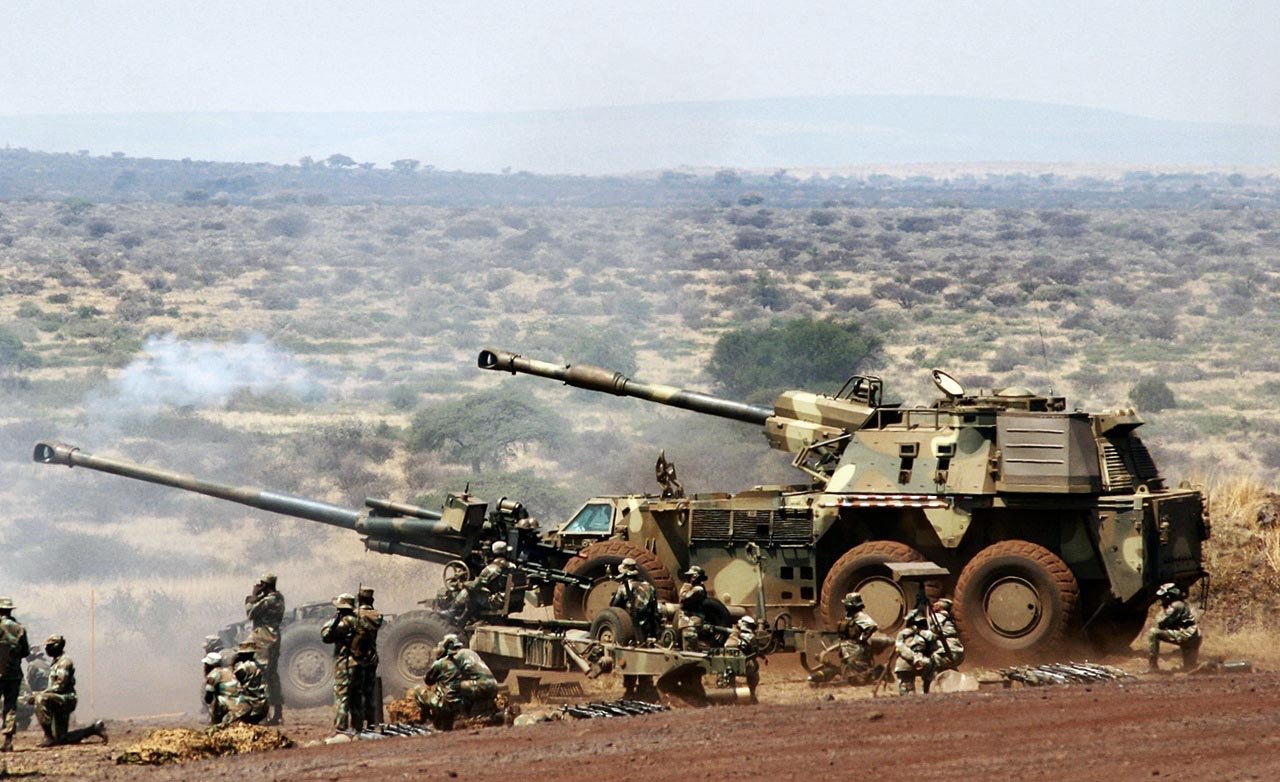
(GV6 image). G6 Rhino can enter and exit firing position in 1 minute, giving it a great shoot-and-scoot capability. The maximum range of the 155/45mm howitzer depends largely on the type of ammunition but with standard HE rounds it is 30 km, with HE base bleed rounds it is 40.5 km, and with Velocity Enhanced Long Range Artillery Projectile (VLAP) it is 52.5 km. It is possible fire directly at targets located up to 3,000 meters away thanks to a gun-mounted telescopic sight and a laser range-finder. The G6 is a fairly accurate artillery system with an estimated error of less than 0.38% of range against targets located at 22.5 km away using standard rounds, or in other words, a maximum circular error probability (CEP) of 85 meters. Of course, with guided rounds this CEP is reduced to 5 meters against targets located 38 km away.
gv642
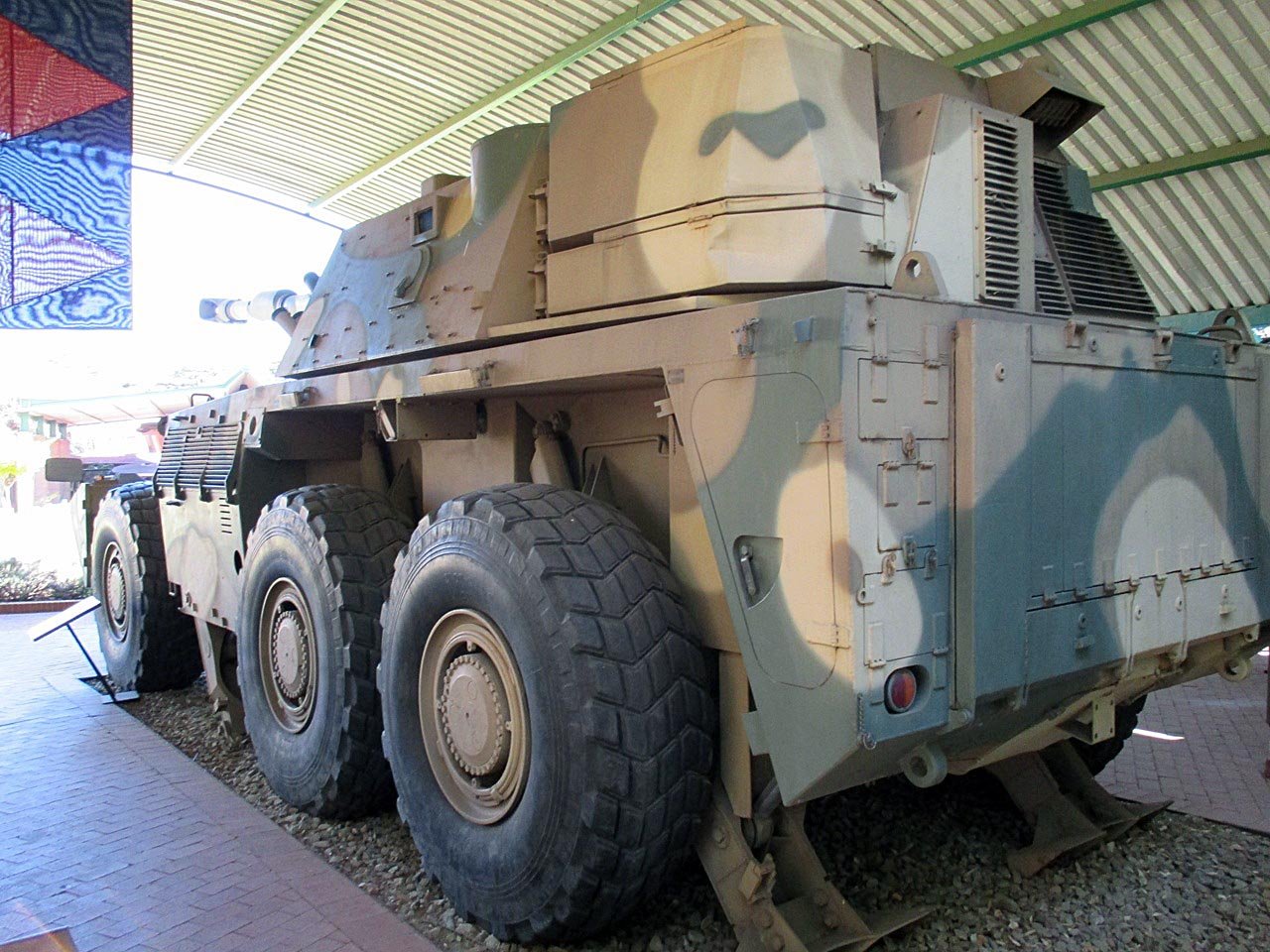
(GV6 image). The 155mm ammunition used is of the Extended Range Full Bore (ERFB) type, and the G6-45 and G6-52 carry 44 rounds stored in racks located at the rear of the vehicle and that are accessible from the outside. It also carries 50 charges, 64 primers, and 64 fuses. The G6 Rhino self-propelled howitzer uses the Somchem M64 Bi-Modular Charge System (MCS) which improves muzzle velocity, reaching 911 m/s for standard HE rounds and 909 m/s for HEBB (base bleed) rounds. The base bleed unit is a screw-on type and can be removed from the shells if the firing mission does not require its use. The shell and propellant charges are placed in the rammer tray by hand, by the ammunition handler and the breech operator respectively, but to the left of the breech is a semi-automatic hydraulic flick rammer that feeds the round into the chamber for firing. The rammer is operated by the ammunition loader and can be used at any barrel elevation angle.
gv612
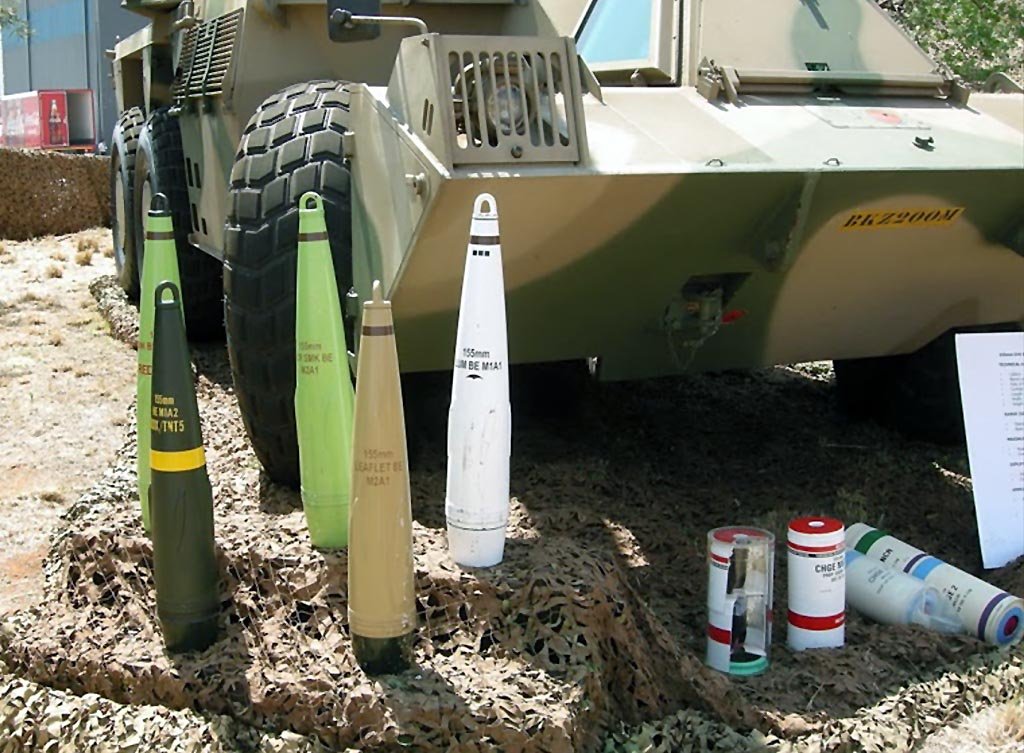
(GV6 image). This howitzer can fire all NATO 155mm ammunition, although it uses South African ammunition developed and manufactured by Rheinmetall Denel Munitions. The ammunition range includes: M1 series Extended Range Full Bore (ERFB) and Extended Range Full Bore-Base Bleed (ERF-BB) HE rounds, M9703 HE-VLAP (base-bleed and rocket motor assisted) round, high-explosive fragmentation (HE-FRAG) round, screening smoke (SCR SMK) round, bi-spectral screening smoke round, illumination round, red phosphorus round, submunition (Cluster) round, incendiary round and leaflet (propaganda) round. The smoke shell generates a smoke cloud for two minutes thanks to four canisters. The illuminator round illuminates an area with a light intensity of 1,000,000 candelas for two minutes, and the submunition round consists of 42 anti-personnel or armor-piercing rounds that can penetrate up to 120mm of armor. The projectiles can be fitted with contact, proximity, direct (SQ)/delay, and electronic time fuses.
gv628
(GV6 image). The G6 Rhino‘s fire control system (FCS) is designed for indirect fire on the target and receives information from forward observers. These observers transmit this information via the Artillery Target Engagement System (ATES) to the fire control post, which then sends it via VHF radio to the Launcher Management System (LMS) installed on each vehicle. In addition, each vehicle has a weather station, an ammunition control system, and a muzzle velocity analyzer/radar to calculate firing coordinates.
gv62
(GV6 image). The commander operates the Gun Management System (GMS), which, through a Gun Display Unit (GDU), provides situational data, fire orders sent from the command post, weapon status, and other operational information. The vehicle also features a Laying and Navigation System (LNS) that displays maps with safe routes, danger points, and known enemy positions. Additionally, it has a Muzzle Velocity Radar System (MVRS) located above the rear of the barrel. This device is connected to the GMS and displays calculations of the probable muzzle velocity based on previous firings of different types of ammunition. The GMS system also features a Thermal Warning Device (TWD) that warns of barrel and recoil system overheating via a warning on the commander’s display and an audible alarm through the intercom system. For these situations, the vehicle is equipped with a barrel-cooling fan for faster cooling.
gv626
(GV6 image). The Gun Management System (GMS) also controls ammunition usage via an Ammunition Display Unit (ADU). This system is located on the rear left of the vehicle and displays the type of ammunition required and the howitzer’s position to external servers. The G6 Rhino features a modern Laying and Navigation System (LNS) and was the first self-propelled howitzer with full autonomous laying and navigation capabilities. This system uses an RLG (Ring Laser Gyro) inertial unit combined with a GPS that gives an all-weather day and night combat capacity without the use of external references, maintaining constant situational awareness of the vehicle and the weapon’s orientation.
g64513
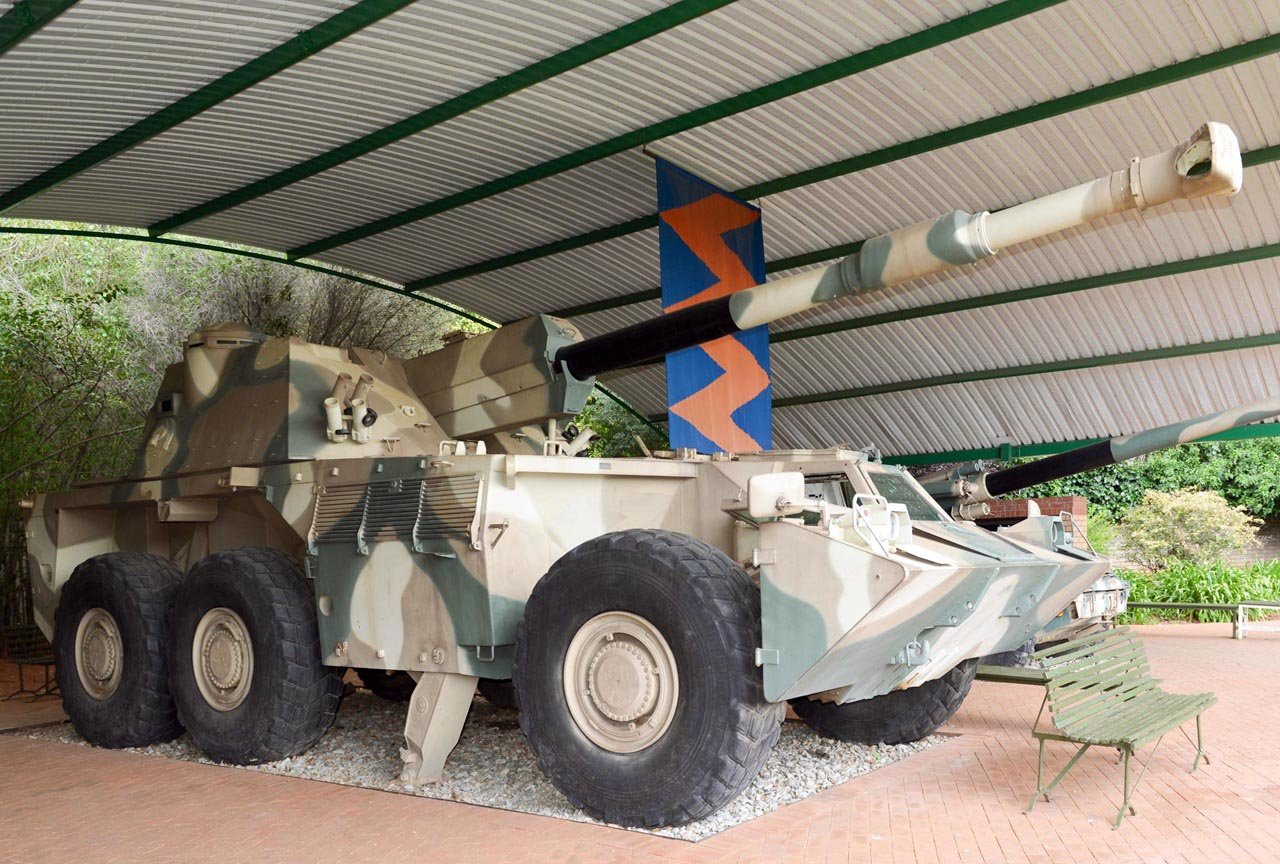
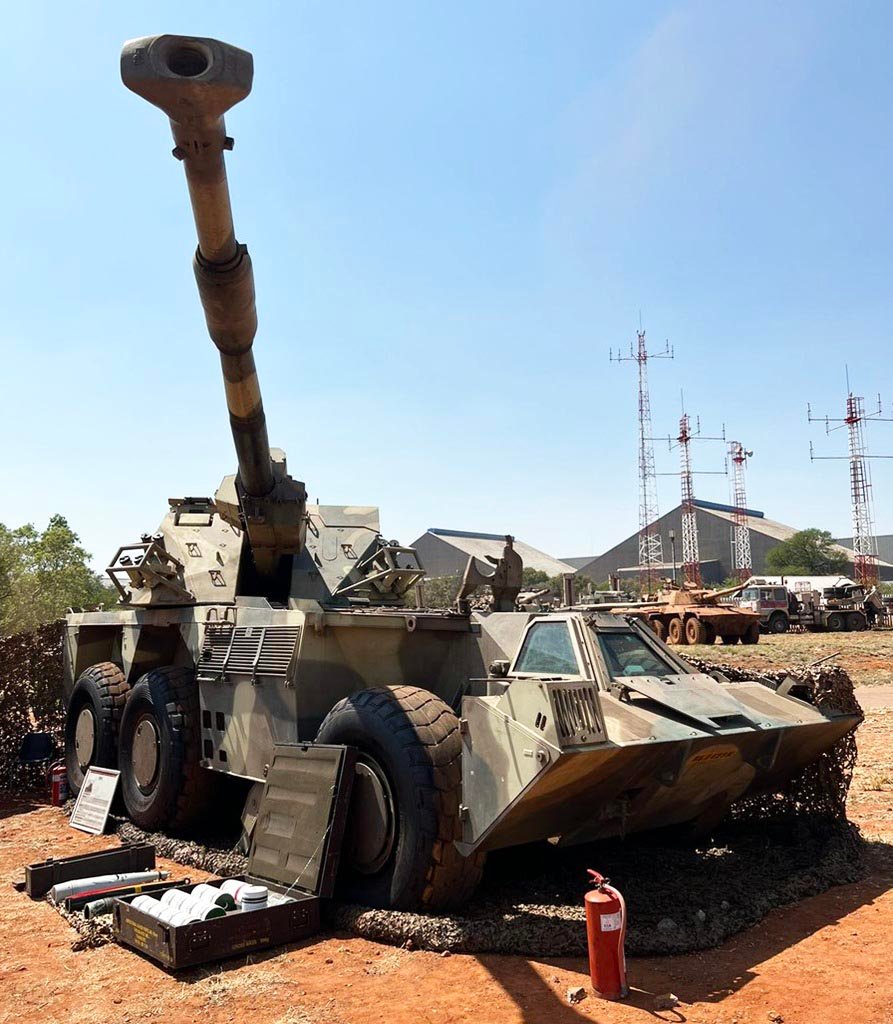
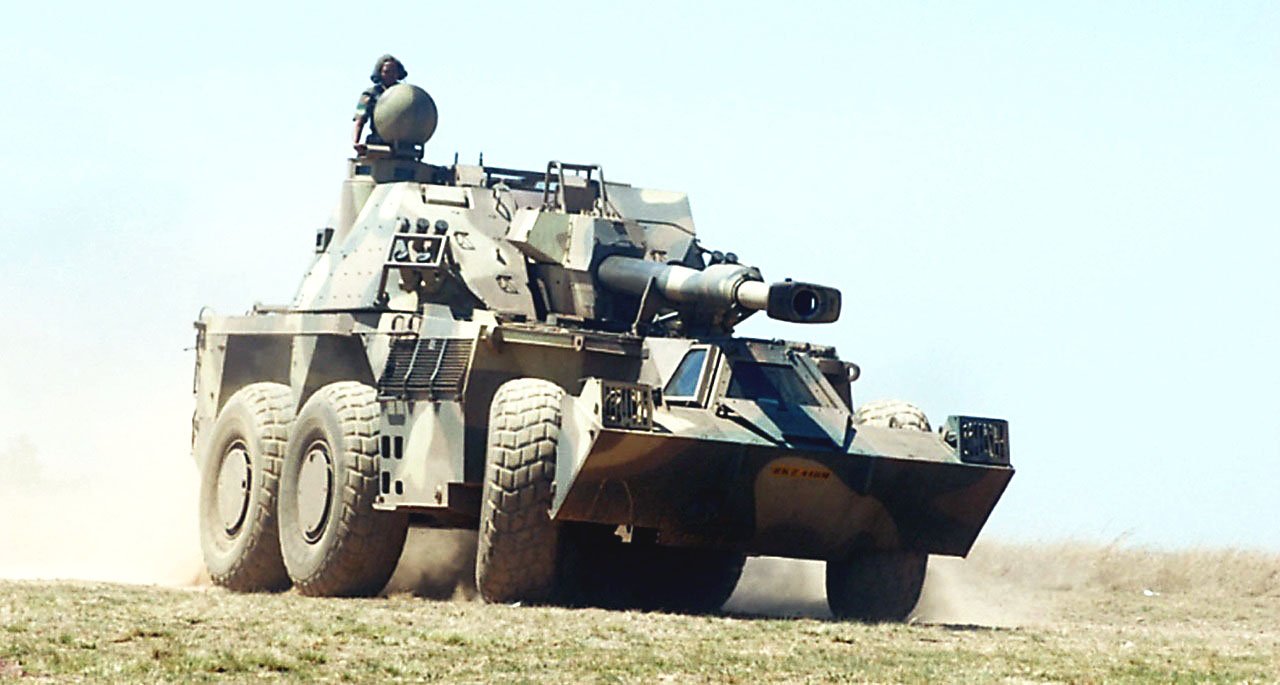
The South African Army placed an order for 43 G6-45 (on the image) self-propelled howitzers, which were delivered starting in 1988 and distributed in batteries of six howitzers each. In 1996 it was made public that the South African G6s were going to receive a package of improvements and modernizations. The pack included a new air conditioning system with separate air conditioning for the driver’s compartment, improved vision elements, improved rust and corrosion protection, a new overpressure type NBC protection system, a new 38 Kw APU, a new barrel-cooling fan system, an upgraded recoil system, a new GEC-Marconi FN23110G automatic gun laying and navigation system with its own fire control computer, new Kentron ring laser type gyroscope, touch screen display and sensors and other chassis/hull improvements to ease maintenance.
gv64
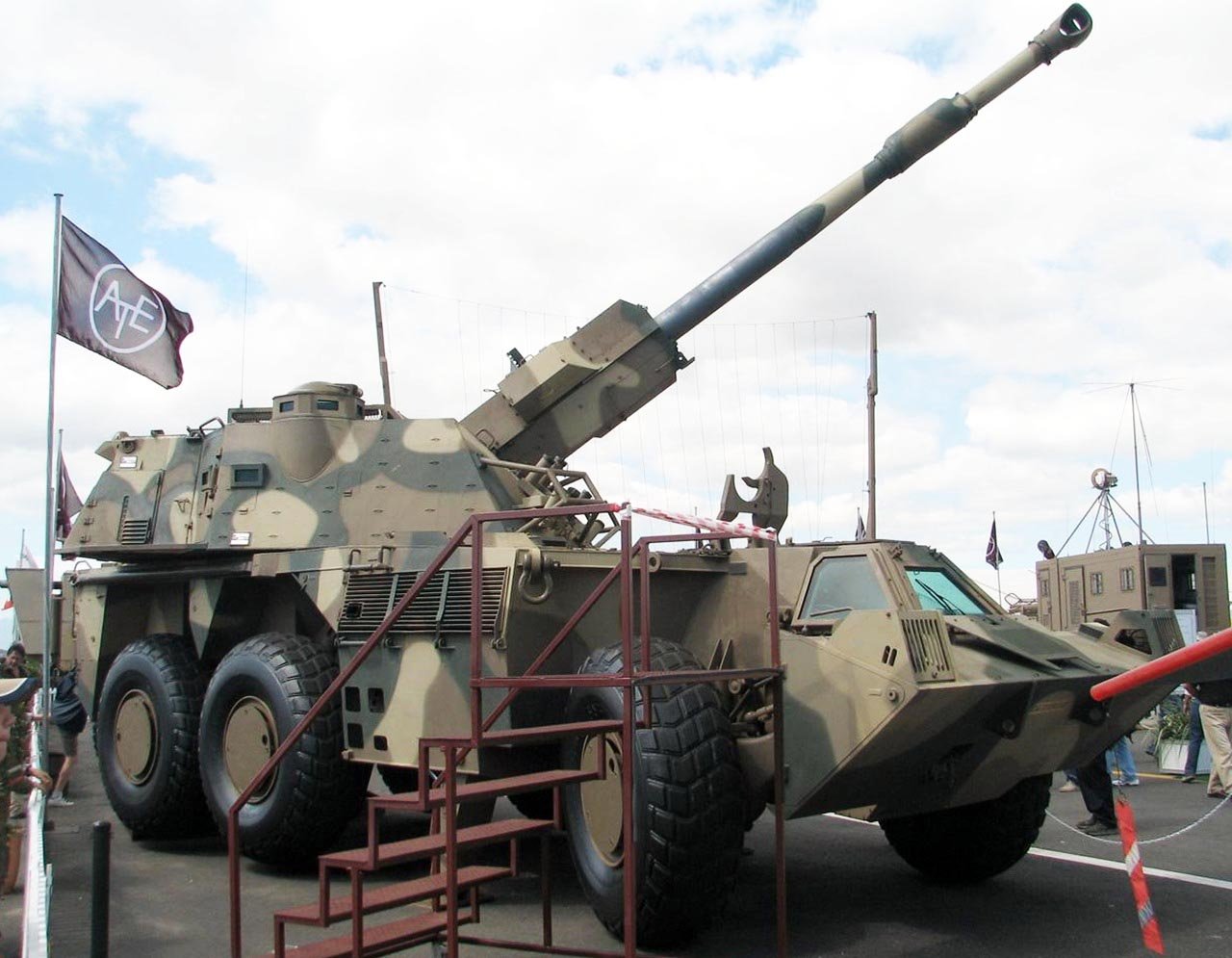
Within the SADF, the upgrade vehicles are known as “GV6 Rhino” (on the image). However, the number of modernized vehicles is unknown. There were also plans to replace the 155/45mm barrel with the 155/52mm, but due to persistent budget constraints, this upgrade appears not to have been implemented yet, at least not on all vehicles. Currently, the 43 vehicles acquired remain in service but in peacetime, only 9 vehicles are kept active, while the rest are in storage.
g6preserie1
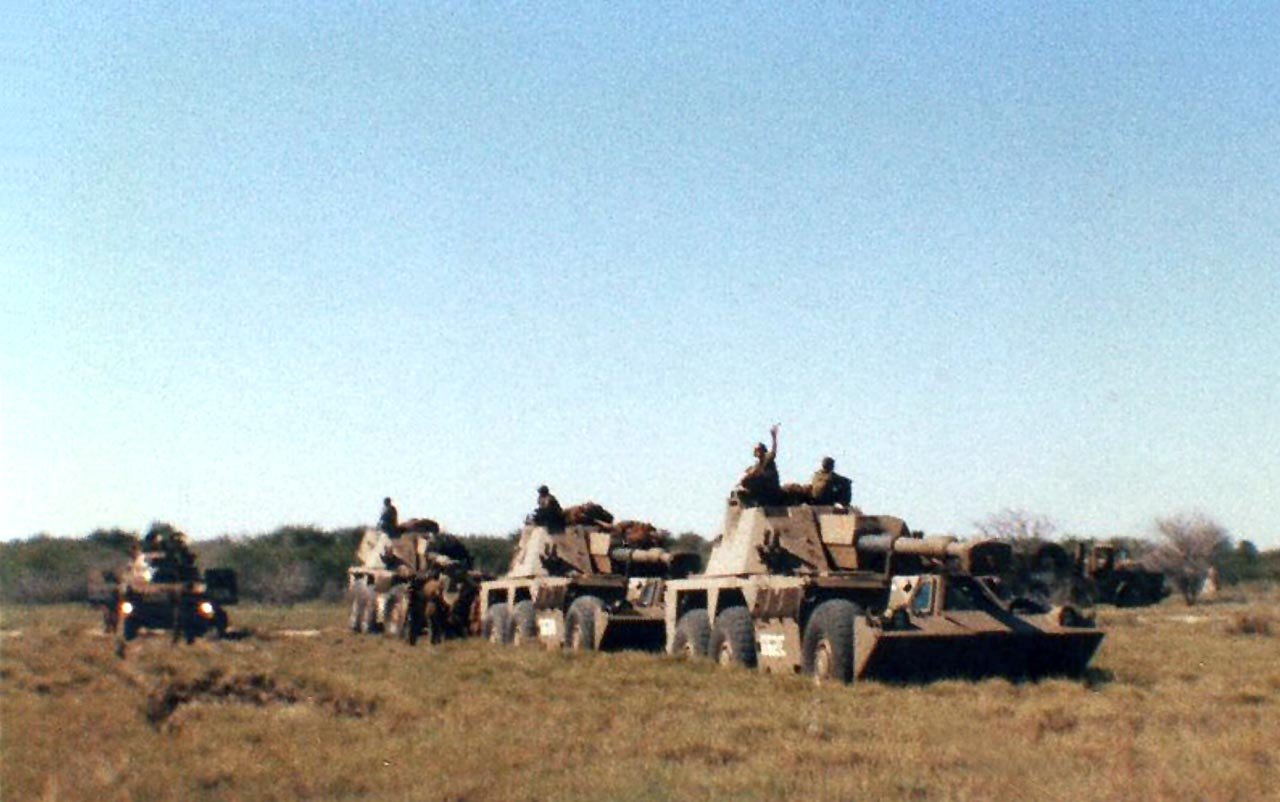
(pre-production G6-45 image). The first four pre-production vehicles were deployed in 1987 to an assembly area located at northern Namibia, as part of Operation Modular. This area was at 2,500 km from the Army’s Artillery School of Potchefstroom and they made the journey under their own power. Only one vehicle experienced some mechanical problems, which were resolved in the same assembly area, allowing them to rejoin the fight without problems.
g6preserie2
(pre-production G6-45s image). The four vehicles formed an independent battery that joined the 4th South African Infantry Battalion (4SAI) expeditionary force and attacked military targets belonging to the Angolan MPLA and FAPLA guerrilla movements. Their most renowned action was the attack on the Cuito Cuanavale airfield, where they destroyed four Angolan MiG-21 fighters. Their excellent mobility and shoot-and-scoot capability were demonstrated, and after their mission, they returned without breakdowns to the Potchefstroom Artillery School under their own power, demonstrating remarkable mechanical reliability. Later, they were deployed in two United Nations peacekeeping missions carried out in Burundi in 2001, and the Democratic Republic of Congo in 2010.

Related posts