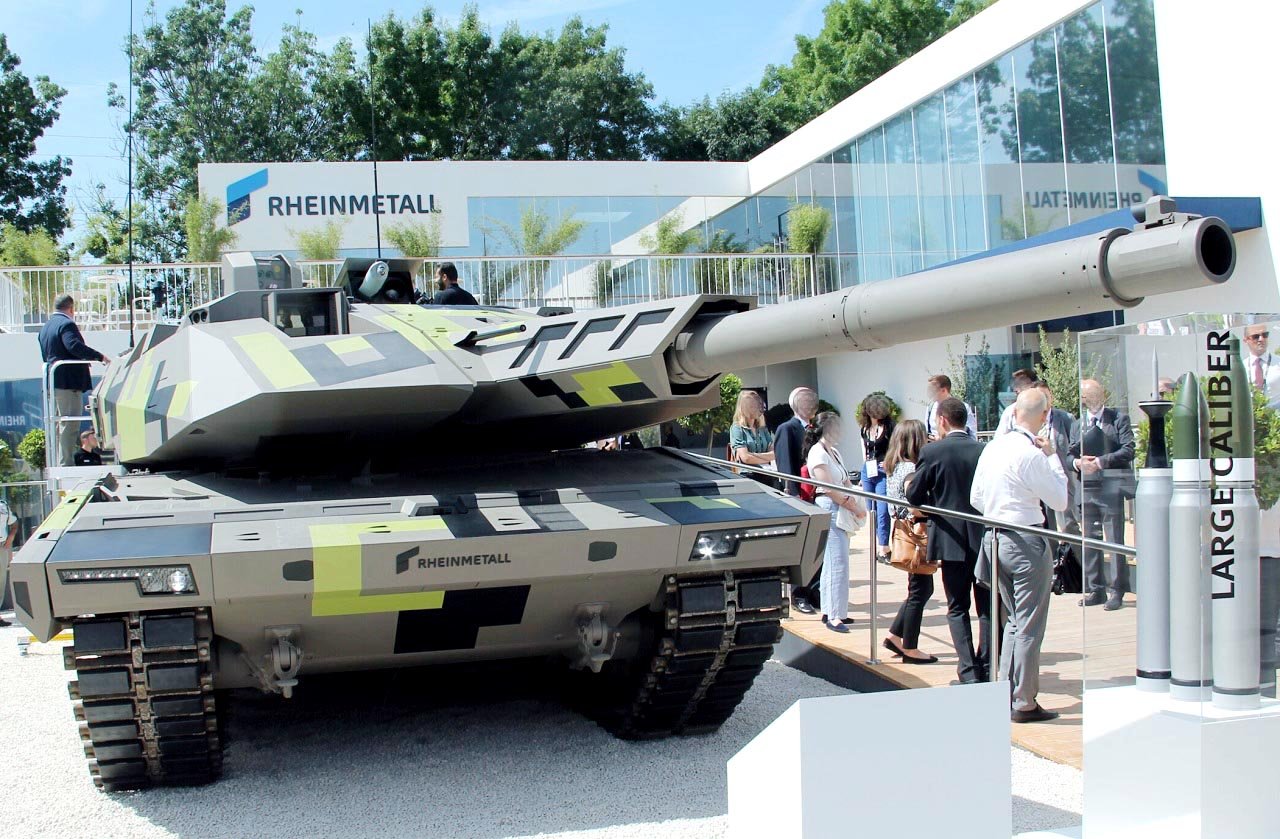
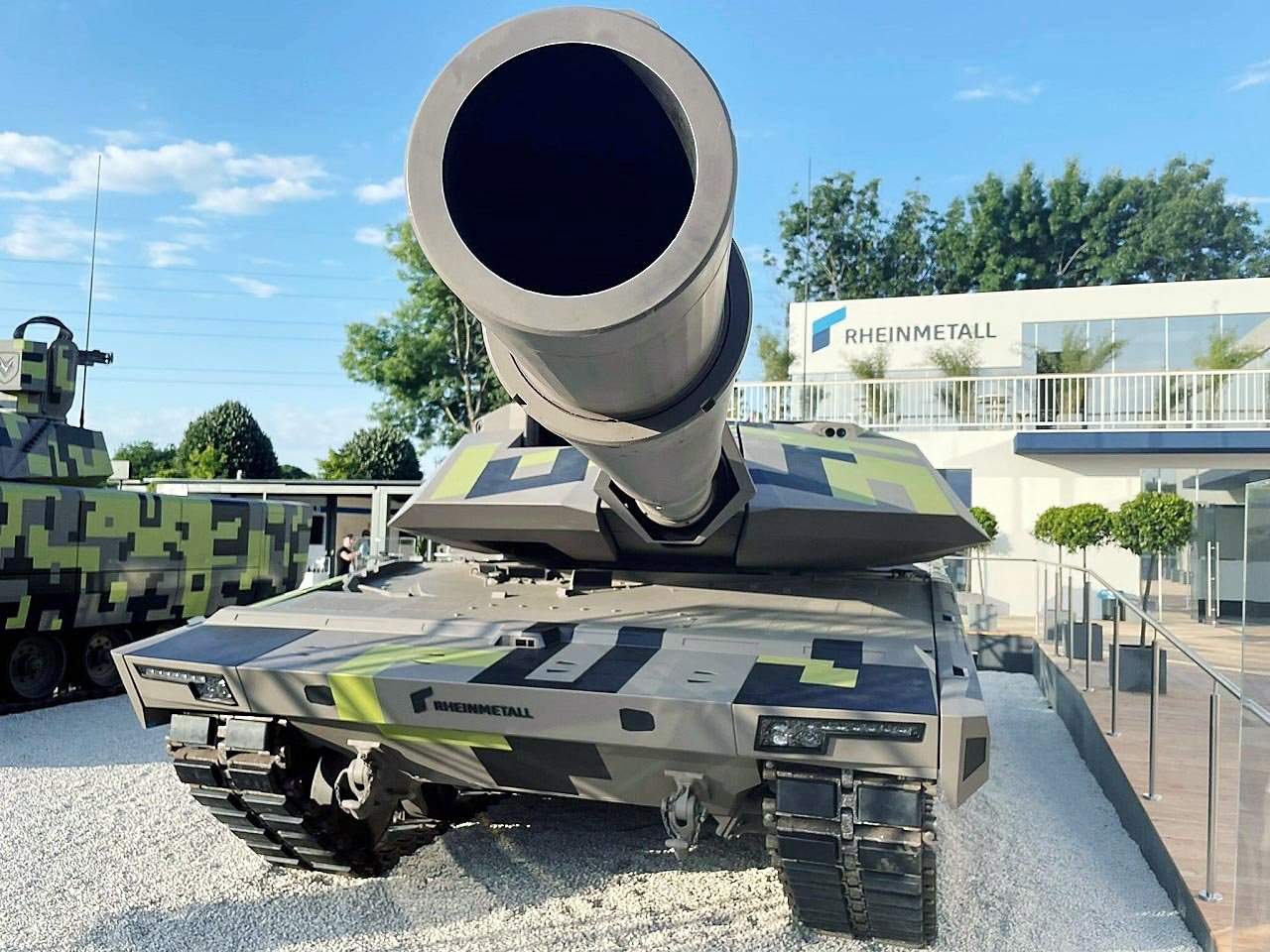
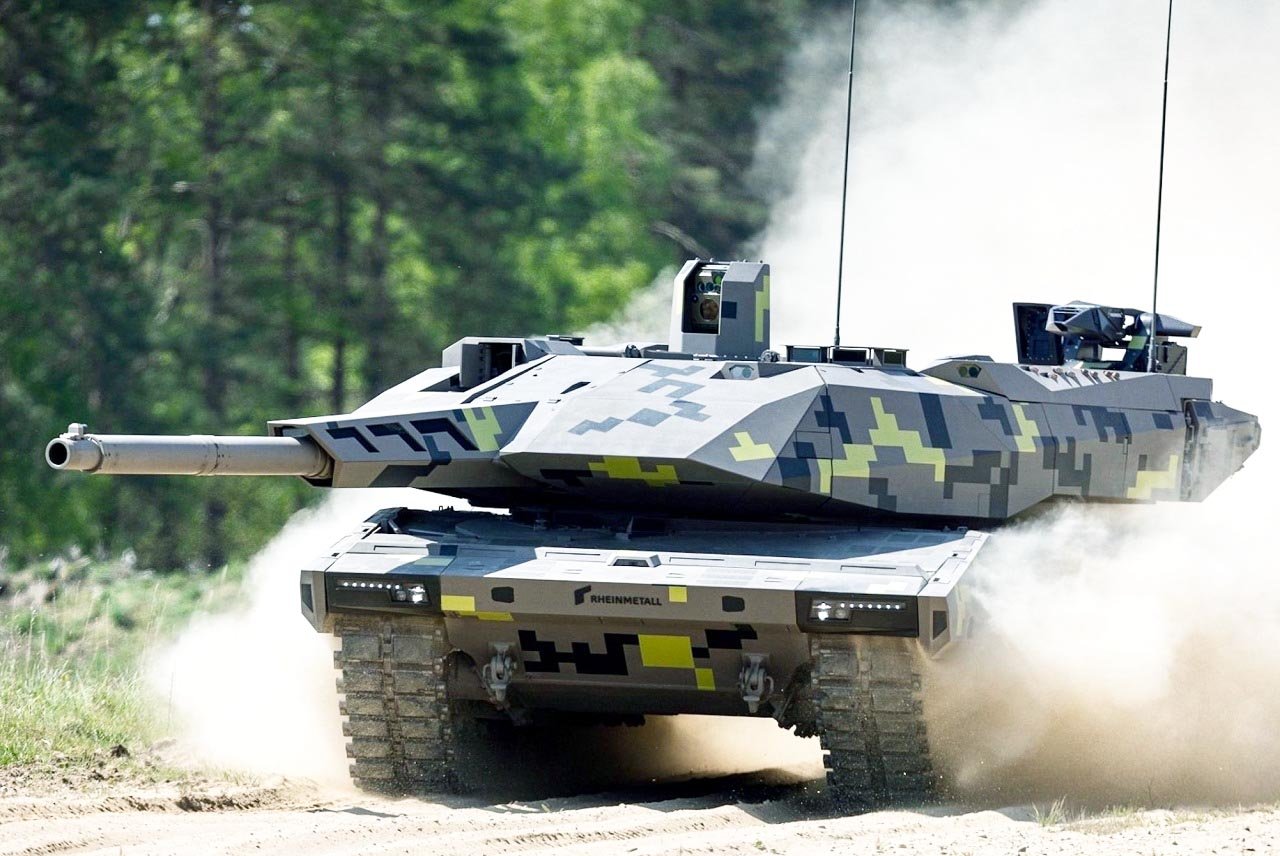
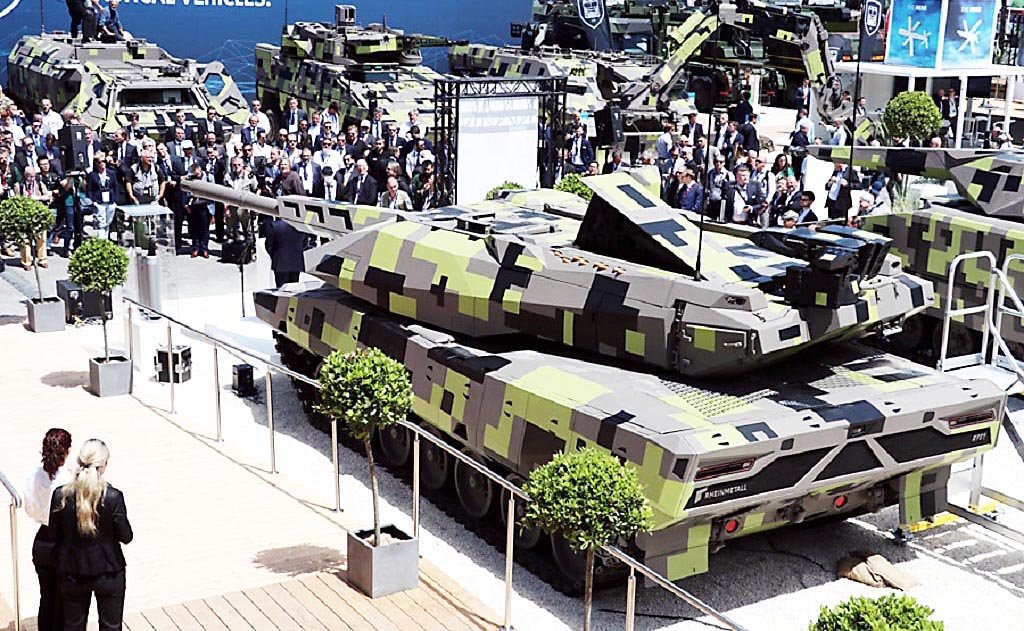
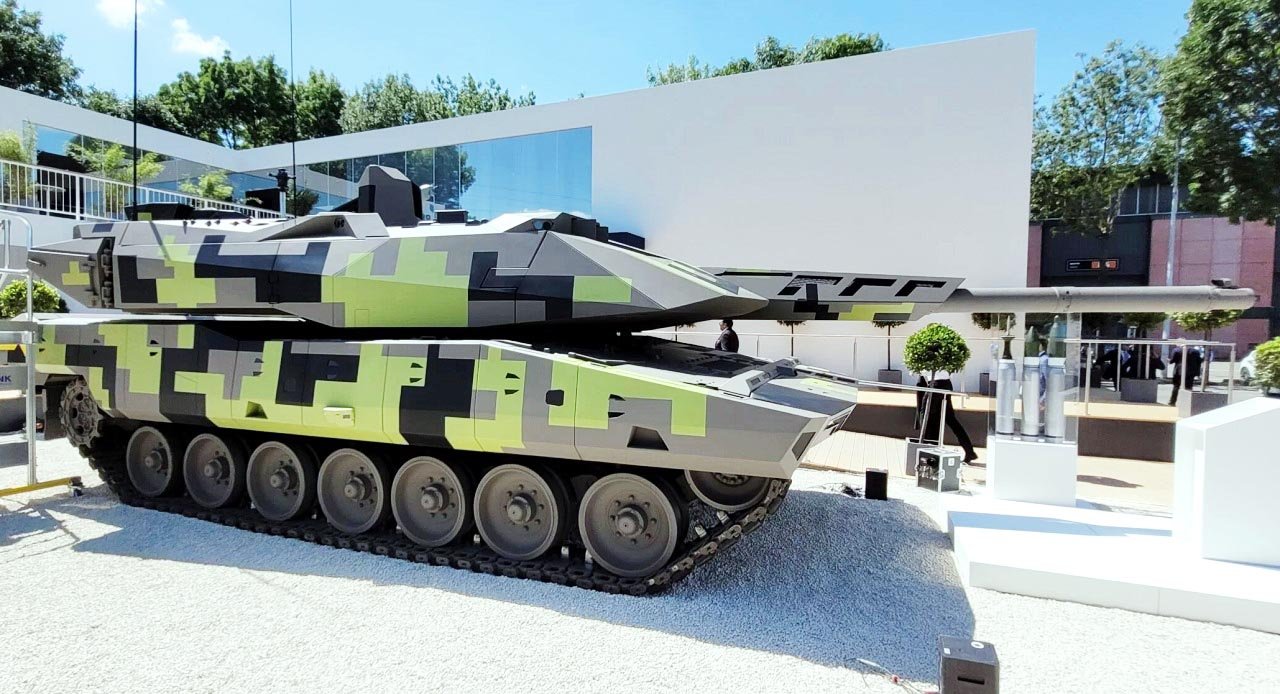
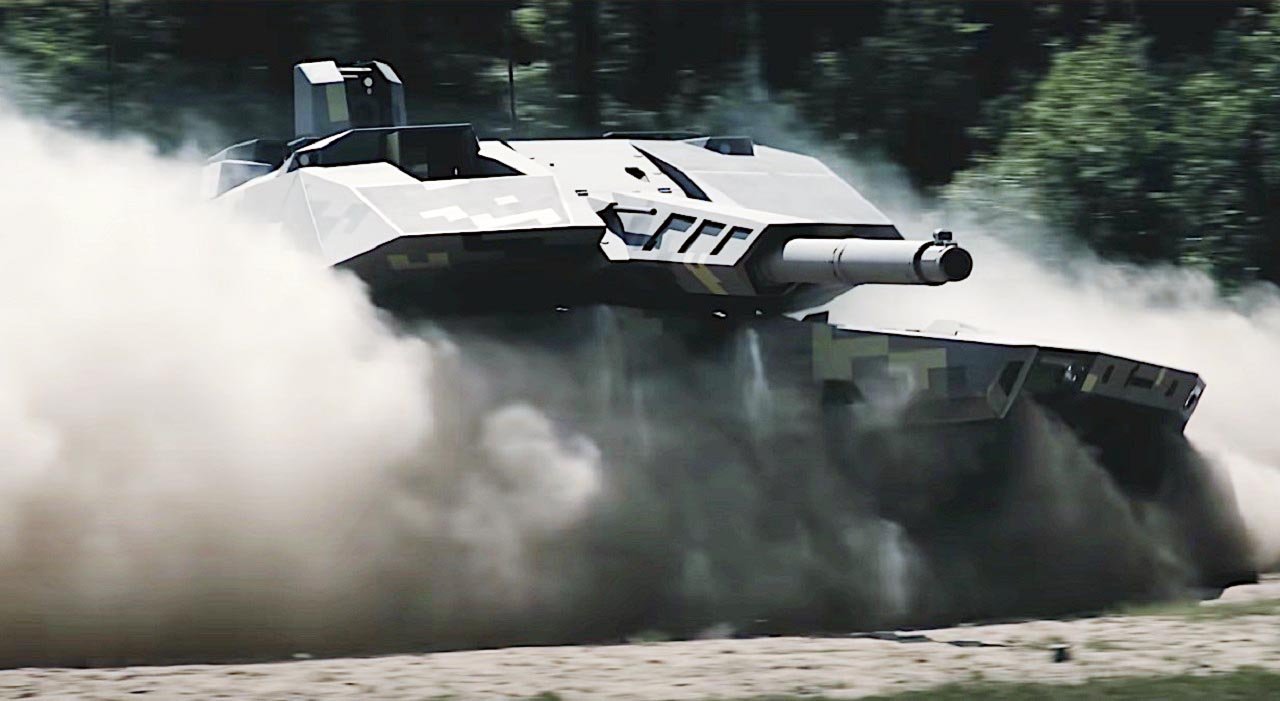
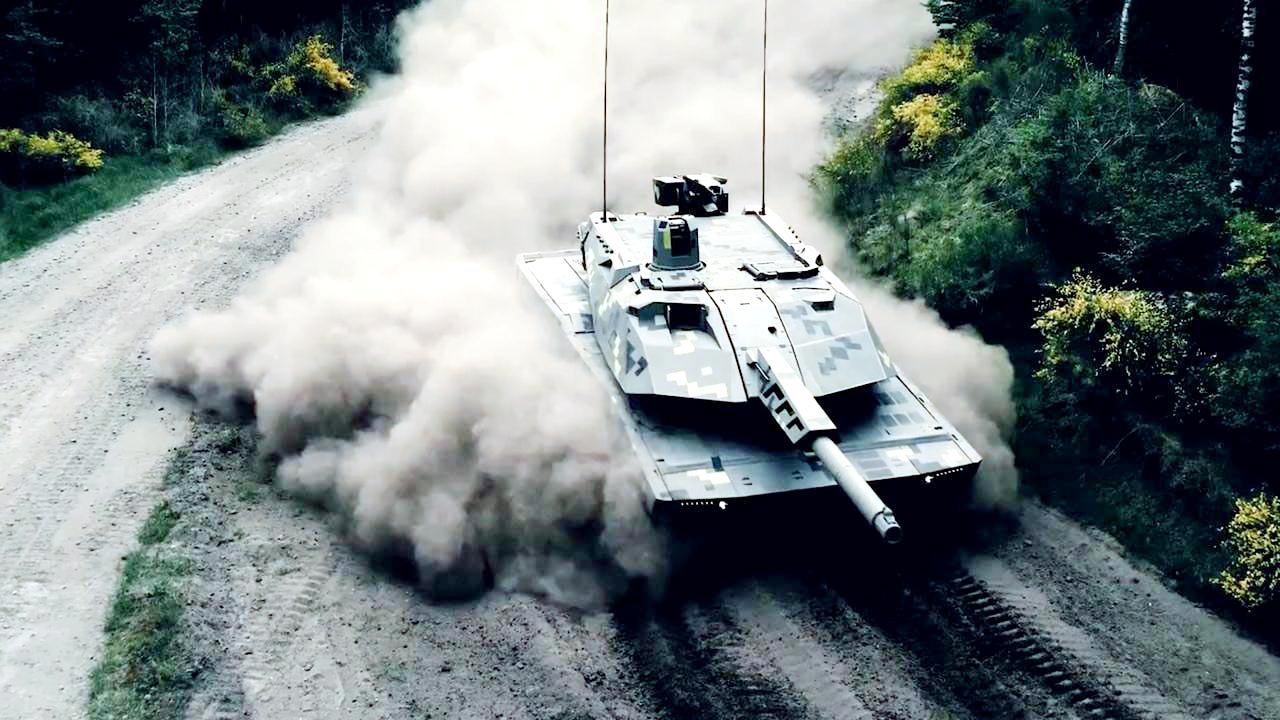
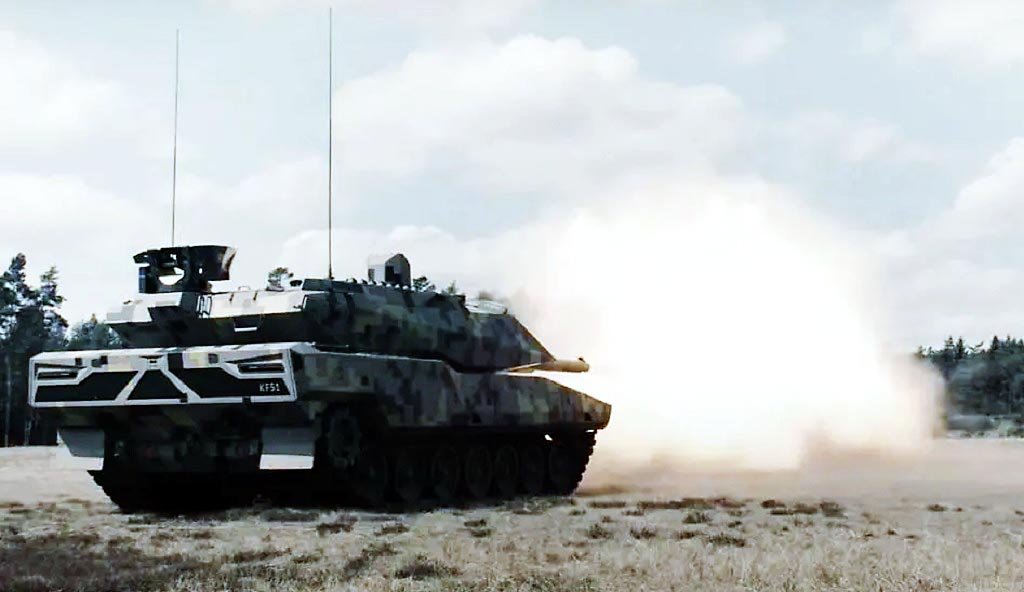
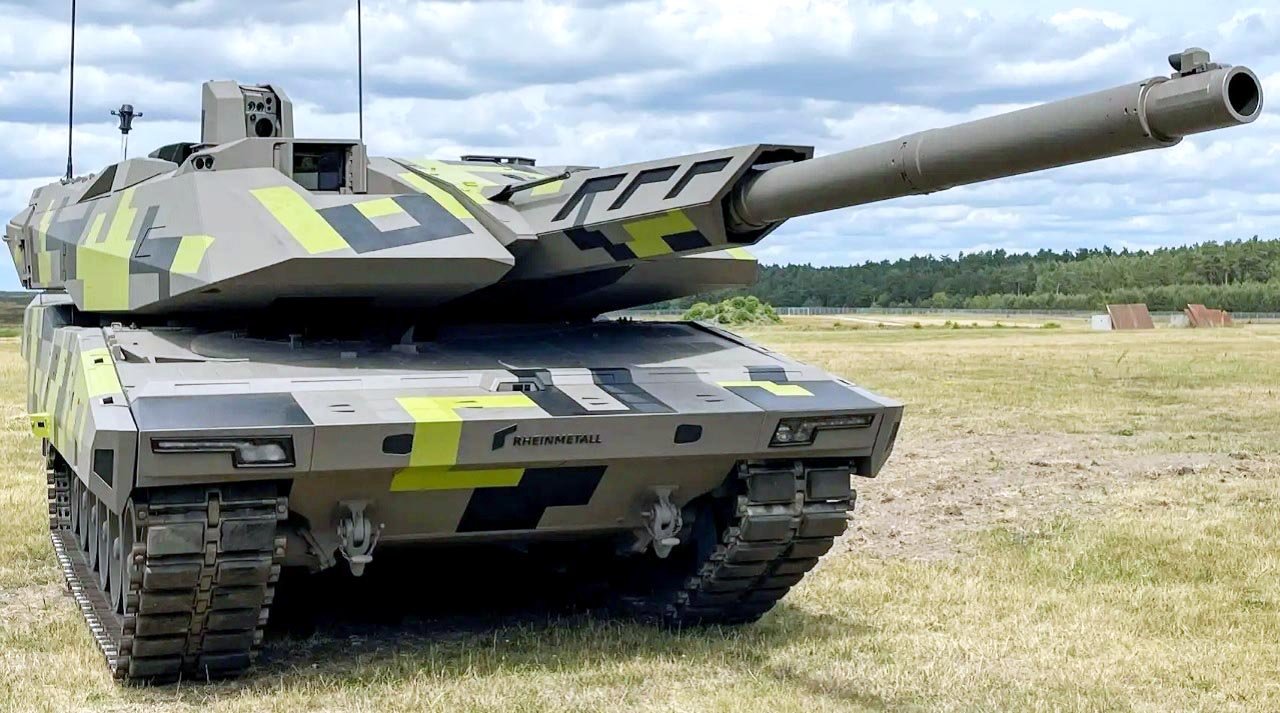
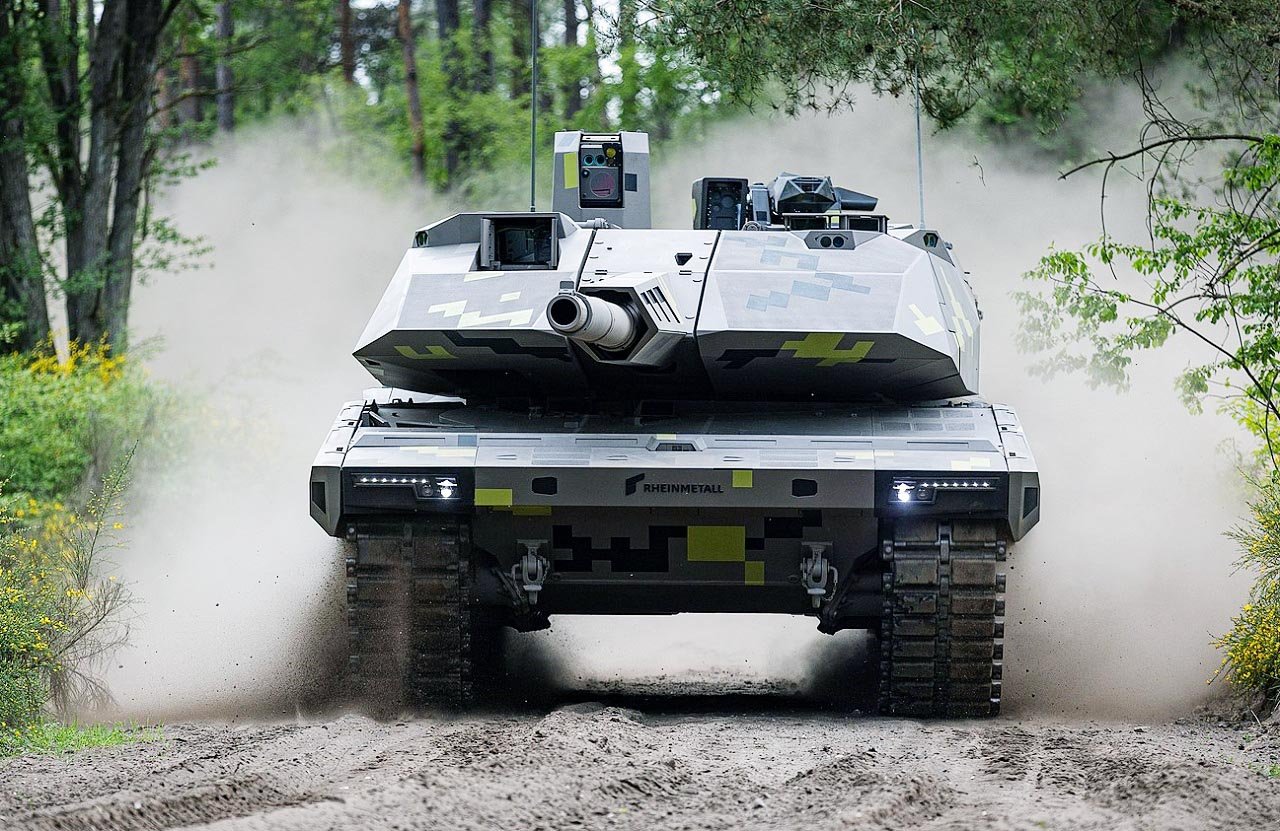
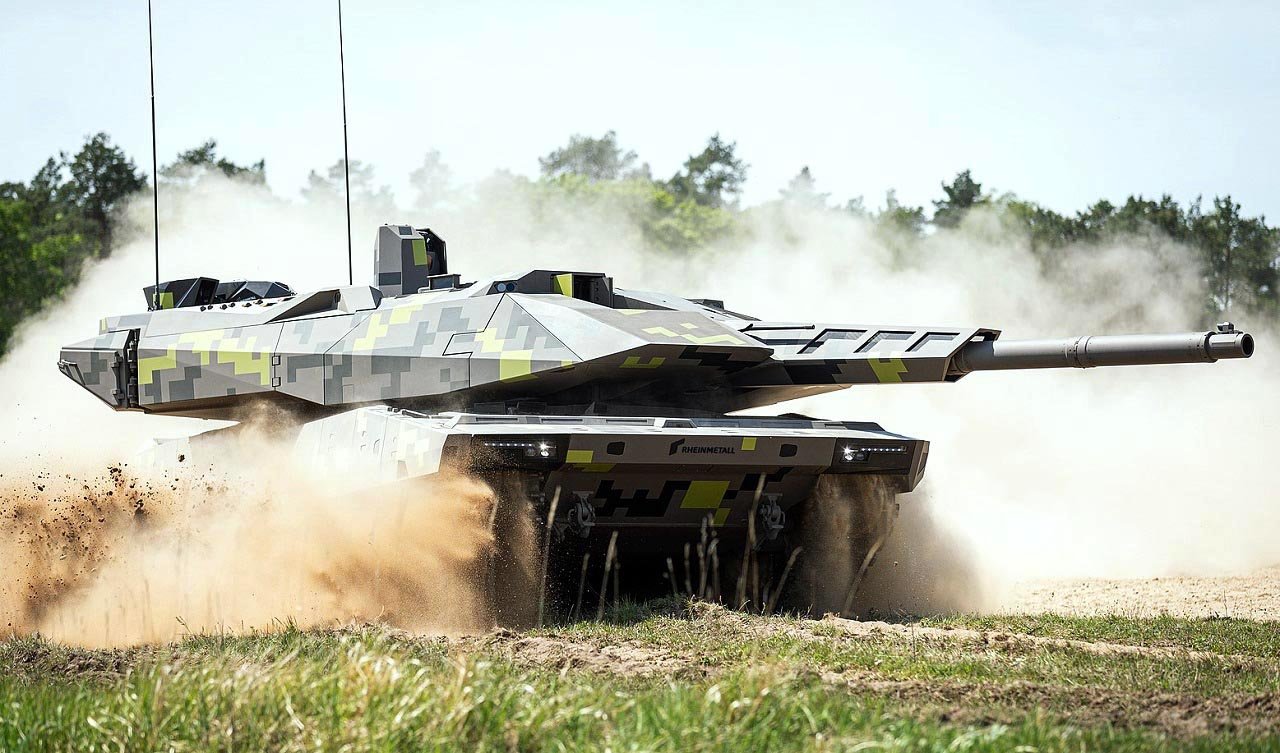
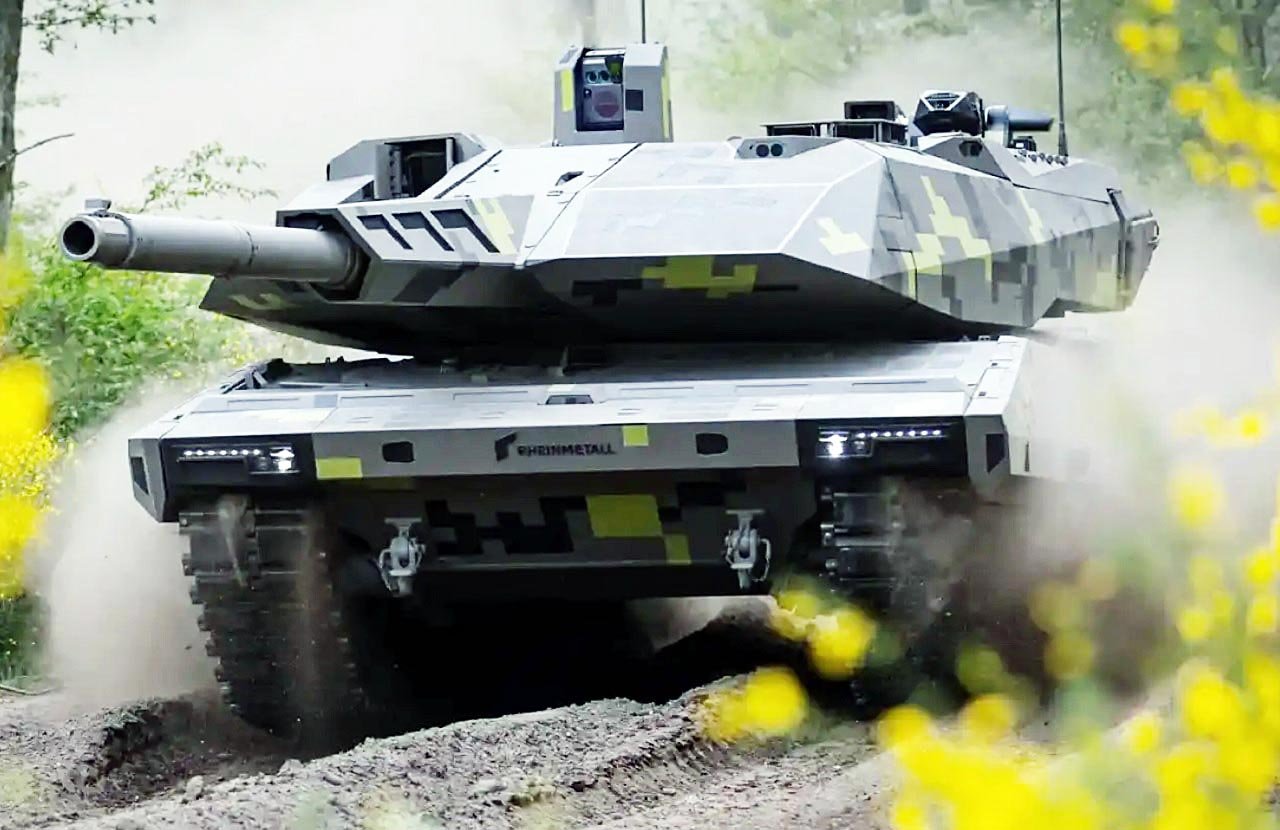
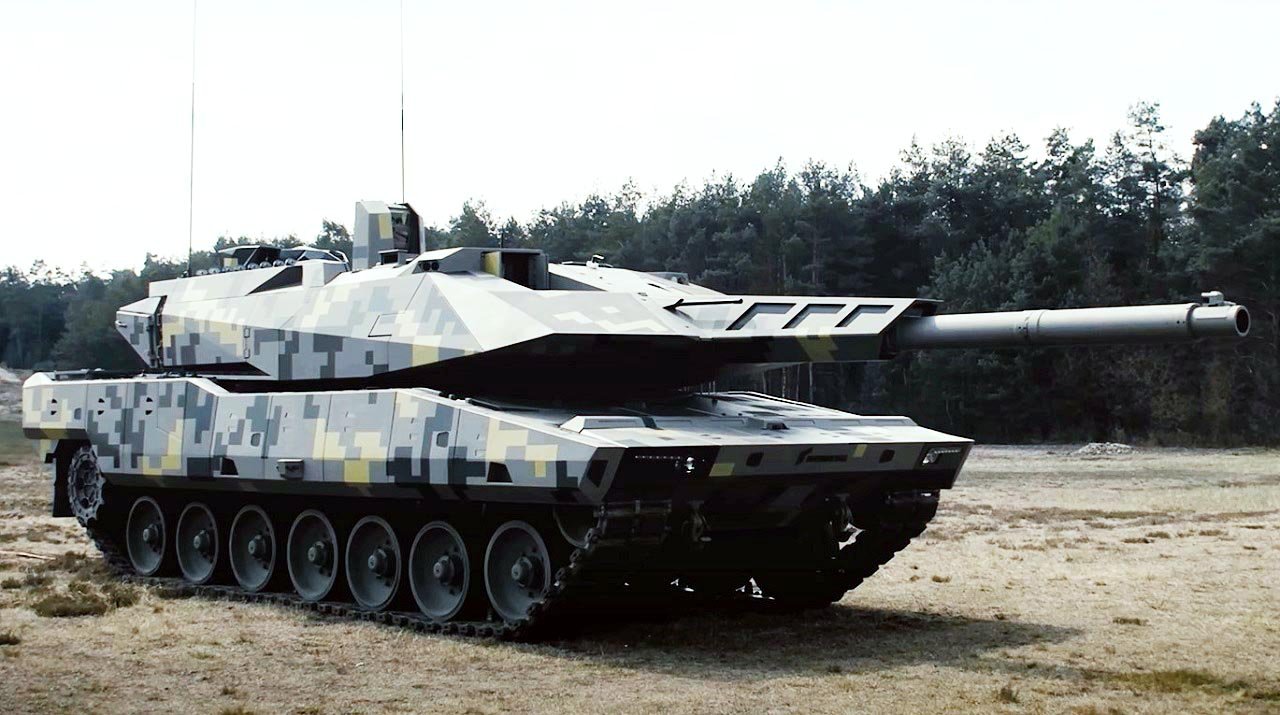
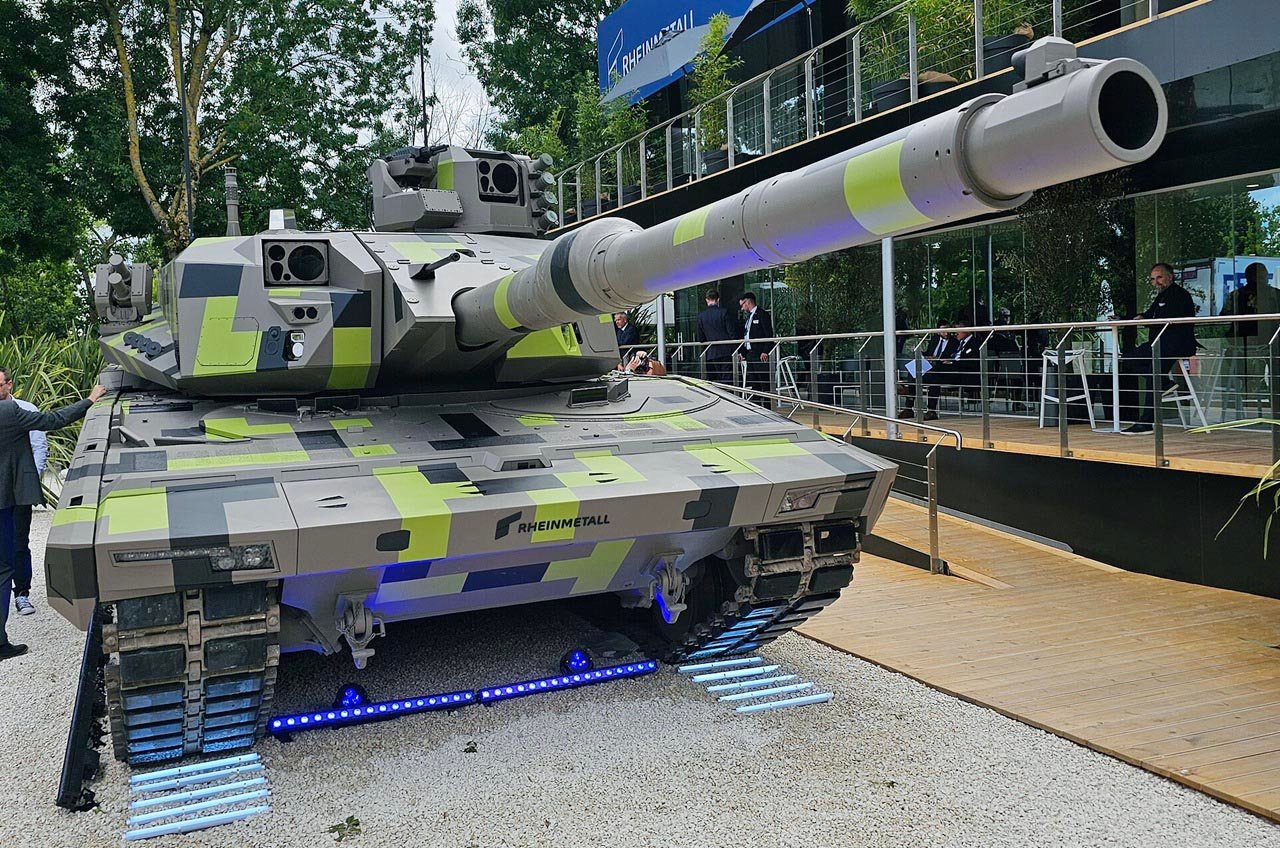
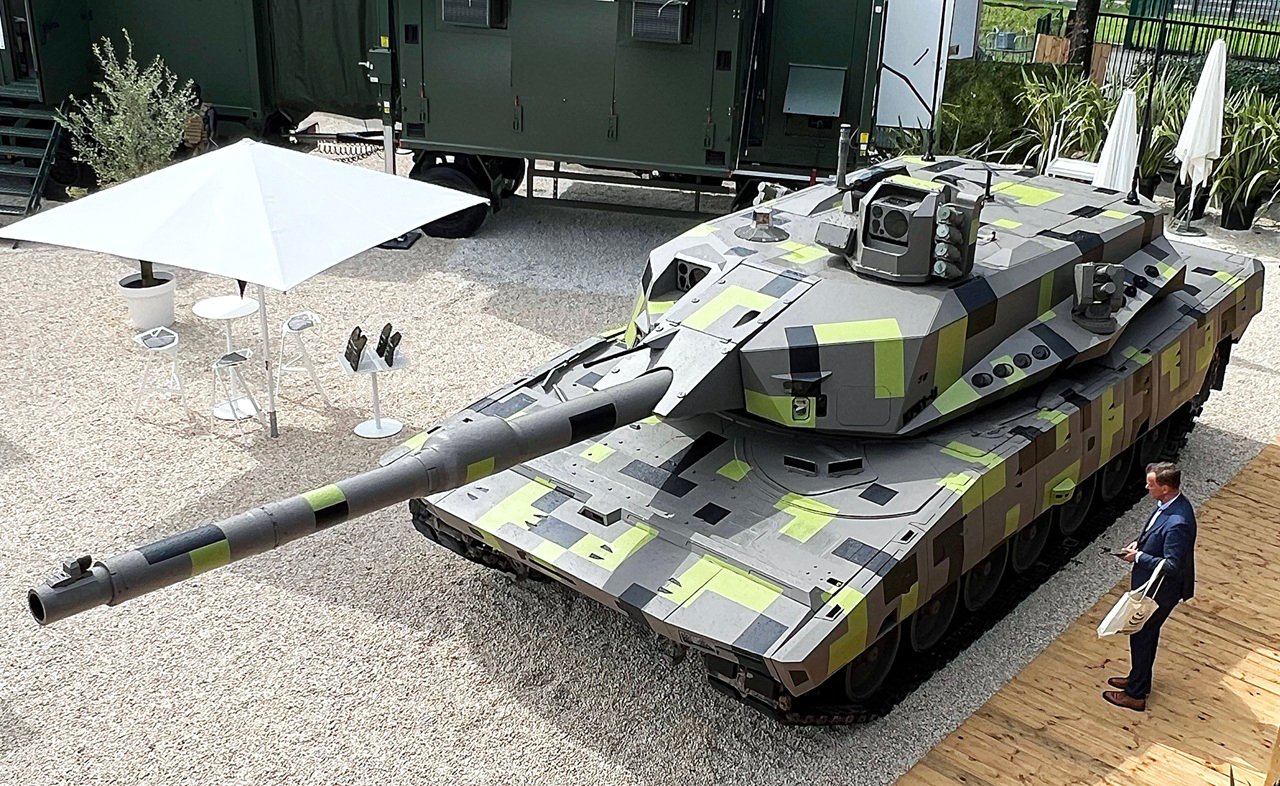
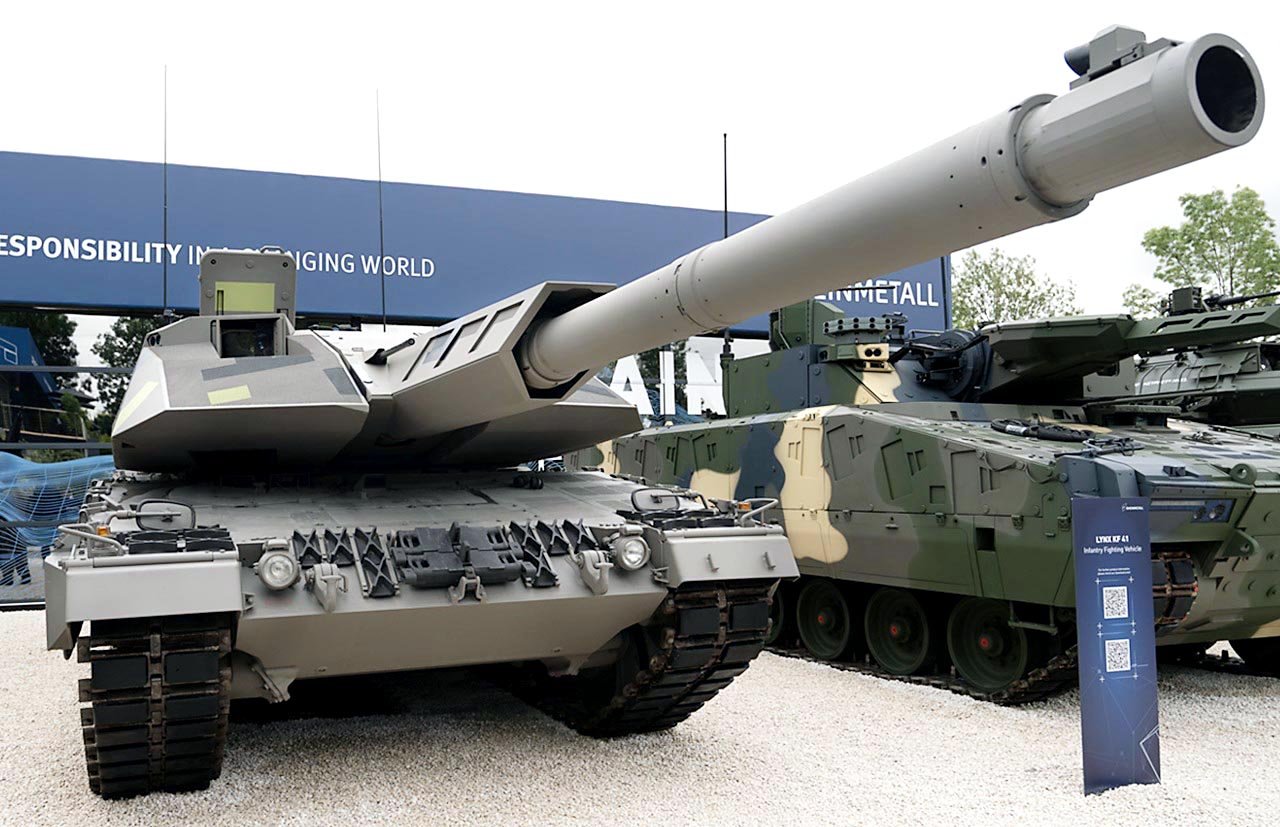
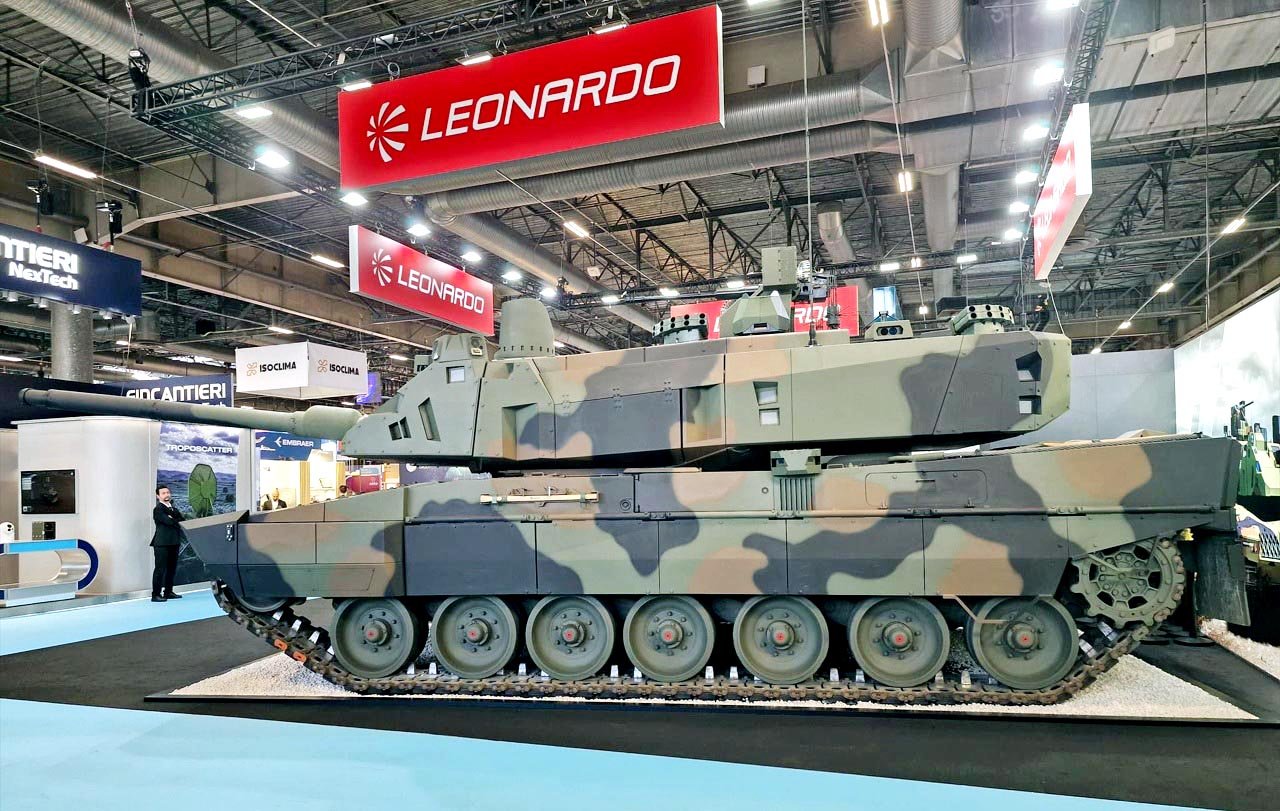
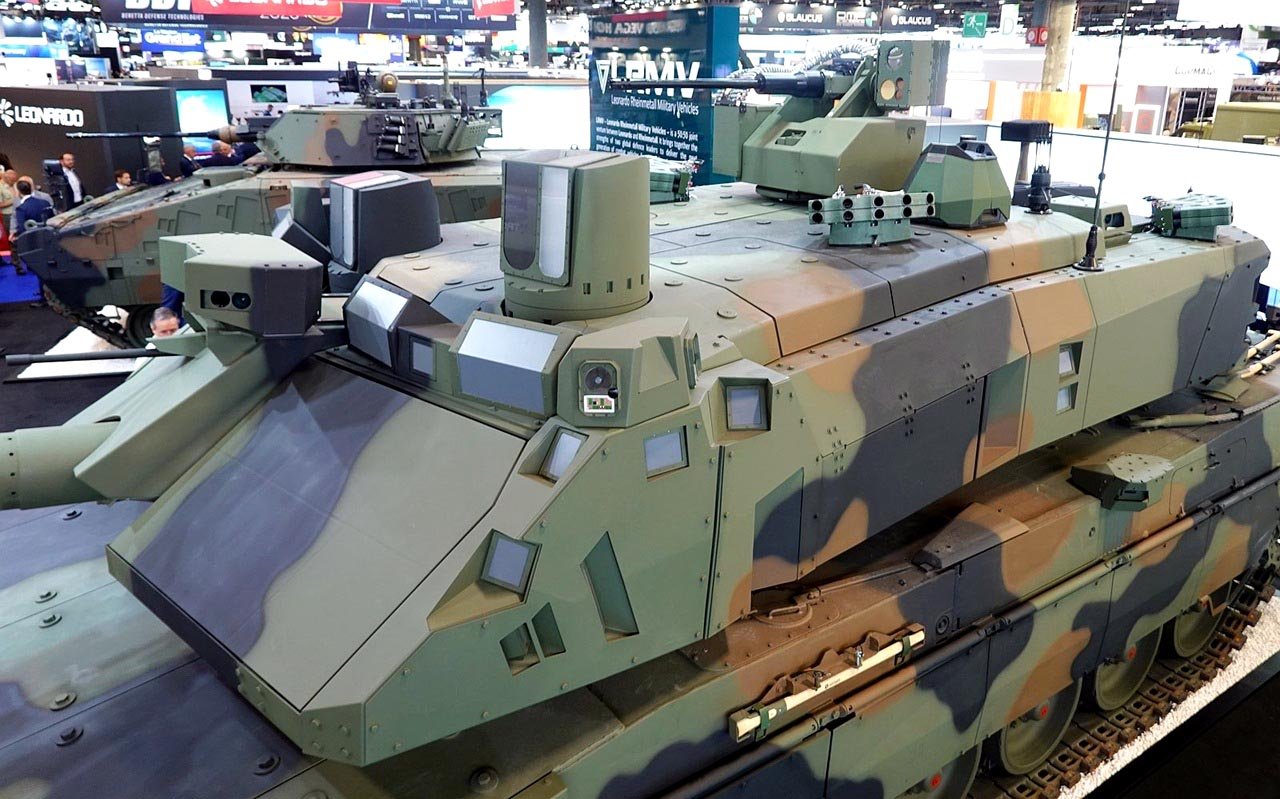
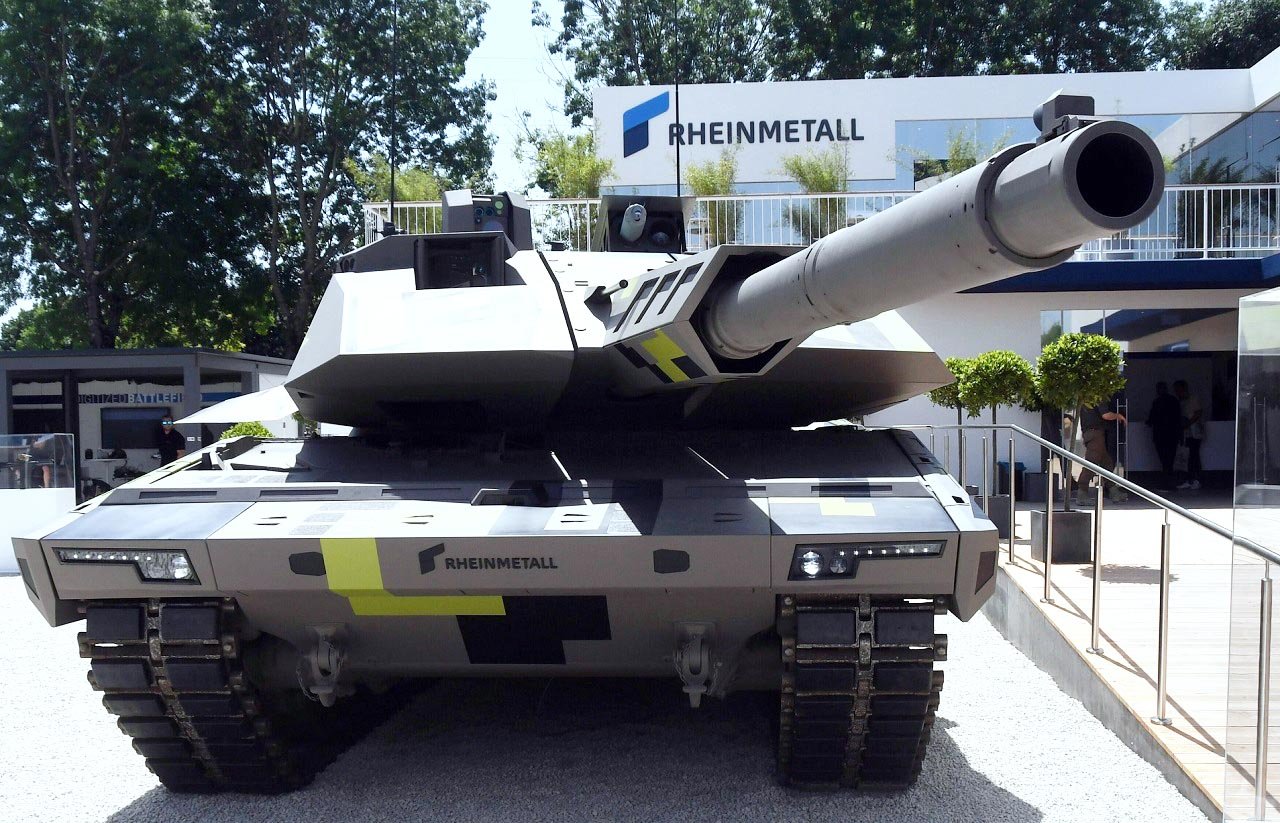
(Panther KF51 demonstrator image). On June 13, 2022, Rheinmetall unveiled a prototype/demonstrator of a new main battle tank, designated as “Panther KF51”, at the Eurosatory defense exhibition in Paris. This vehicle utilizes a modernized Leopard 2A4 MBT chassis with a completely new turret mounting a new 130mm gun fed by an autoloader. The design of this MBT prioritizes mobility, lethality, and survivability over protection, employing more active than passive defense systems. This approach has allowed the vehicle’s weight to remain at approximately 59 tons, which allows this MBT to be transported by rail and pass through NATO AMovP-4L type tunnels without preparation, giving it a strategic advantage over most current MBTs, which do not meet this requirement.(Panther KF51 demonstrator image). Rheinmetall privately began designing the Panther KF51 in 2016, and in 2018 began designing the main systems with the aim of starting production by 2026. Rheinmetall designed this MBT to fulfill a new capability called “dominate and destroy”, installing a new fully automated 130mm gun and the option to operate HERO 120 loitering ammunition from inside the vehicle, allowing for multi-target engagements. The Panther KF51 has been developed with the aim of it being chosen by many of the countries currently operating the Leopard 2 MBT. The prototype uses the hull of the Leopard 2 MBT, although a new hull is planned for production once the Panther KF51 enters service for a customer.(Panther KF51 demonstrator image). The internal layout is conventional, with the driver’s cab at the front, the turret in the middle, and the engine compartment at the rear. The crew consists of three, with the option of adding a fourth crew member as a drone operator or unit commander. The driver is positioned in the front right of the hull, while the commander and gunner are located inside the turret. If a fourth crew member is included, they would be located in the left front of the hull, in a separate crew station. The driver has color cameras at the front and rear of the hull for driving and, like the commander, has a 23-inch main monitor plus two 10-inch screens below it, all three accompanied by two side monitors that display images captured by the left and right situational awareness cameras. This same set of monitors can be installed for a fourth crew member if necessary, but it is not installed in the gunner’s station. The crew stations are standardized and use drive-by-wire technology, so theoretically any crew member can control key systems of the vehicle if necessary.(Panther KF51 demonstrator image). The demonstrator vehicle uses the hull of the Leopard 2 MBT, equipped with the same 1500hp engine coupled to a Renk HSWL 354 four-speed automatic transmission, allowing it to reach 70 km/h. Its range exceeds 500 km, and it can accelerate from 0 to 40 km/h in 8 seconds, although these features can be improved with the installation of a future 1,800hp engine. The running gear consists of seven dual-tired rubber road wheels and four track return rollers on each side, with the idler at the front and the drive sprocket at the rear. The suspension is made up of torsion bars, and the first, second, third, sixth, and seventh road wheels feature advanced friction dampers and hydraulic bump stops to dampen oscillations.(Panther KF51 demonstrator image). Panther’s protection is described as “hybrid” and consists of three layers: active, reactive, and passive. The first (passive) layer, the innermost, is made of welded steel armor covered by passive composite armor modules. The second (reactive) layer is made of sensor-fused reactive armor, and the third (active) layer comprises the third-generation Active Defense System (ADS). This system includes the Rheinmetall TAPS (Top Attack Protection System), the StrikeShield hard-kill system, and the ROSY soft-kill system. The vehicle also features enhanced protection against IEDs and mines. Of course, this tank is fully protected against NBC agents thanks to an overpressure air filtration system.(Panther KF51 demonstrator image). The Active Defense System (ADS) is designed to eliminate almost any threat, from anti-tank guided missiles (ATGMs) to drones. The installed hard-kill system is the Rheinmetall StrykerShield, which consists of several devices mounted around the hull that fire ammunition. This system is capable of defeating ATGMs and RPG rockets using a “light effector” (defined by the manufacturer as “blade energy”), and even kinetic energy penetrators such as APFSDS tank ammunition, for which it uses a “heavy effector” capable of breaking the projectile into several pieces, reducing its penetration capacity by up to 75%.(Panther KF51 demonstrator image). Another part of the Active Defense System (ADS) is a soft-kill system called ROSY (Rapid Obscuring System). Manufactured by Rheinmetall, this system consists of sixteen smoke grenade launchers arranged in pairs on either side of the turret. These are automatically fired by the vehicle’s sensors upon detecting a threat thanks to the “pre-shot detection capability” that detects enemy flashes and laser designators. These multispectral smoke grenades quickly obscure the vehicle and disrupt the guidance systems of various weapons.(Panther KF51 demonstrator image). The final component of the Active Defense System (ADS) is the Top Attack Protection System (TAPS), designed to neutralize aerial threats such as drones or anti-tank missiles and rockets launched from high altitude. This system is not yet fully defined, but it is known that it must include both soft-kill and hard-kill systems capable of destroying a threat up to 30 meters high. Consideration is being given to the possibility of installing a laser beam, a high-rate-of-fire small-caliber machine gun, a grenade launcher system, and a multi-spectral smoke screening system, among other options, along with a range of sensors capable of detecting threats at a distance of approximately 600 meters.(Panther KF51 demonstrator image). The main armament of the Panther KF51 is the Rheinmetall Rh-130 L/52 130mm smoothbore gun, also known as the “Future Gun System (FGS)”. This fully stabilized gun can fire from -9° to +20°. Rheinmetall claims this gun has 50% more effective range than its current 120mm guns and a higher rate of fire thanks to its autoloader, designed by Rheinmetall Air Defence in Oerlikon, Zurich. In trials, this gun was capable of firing three rounds in 16 seconds, including safety checks. It is estimated that this gun is accurate out to 3,500 meters and can penetrate up to 1,000mm of armor at this distance. In tests conducted by the manufacturer, over 300 rounds were fired, resulting in a dispersion of only 30cm when firing four shots at a target 1,000 meters away.(Panther KF51 demonstrator image). This weapon can fire high-explosive (HE) rounds, armor-piercing fin-stabilized discarding sabot (APFSDS) rounds, programmable airburst rounds, and practice rounds. The 130mm rounds weigh approximately 30kg and have a muzzle velocity of about 1,800-1,900 m/s. The Panther KF51 demonstrator carries a total of 20 rounds in two rotary drum magazines, each with a capacity of ten rounds. An additional ten rounds can be stored inside the vehicle. There is also the option to carry another ten rounds in the rear of the vehicle, outside the hull and turret. Magazine reloading is done manually through two hatches located on the sides of the turret and takes about 5 minutes. Upon request, a system can be configured to facilitate reloading entire modules of 10 rounds, already stowed inside.(Panther KF51 demonstrator image). The secondary armament consists of a 12.7mm coaxial machine gun with 250 rounds and a Natter remote controlled weapon station (RCWS) with a 7.62mm machine gun developed by Rheinmetall. This RCWS carries 2,500 rounds and can be mounted on the rear of the turret to serve as an anti-drone defense thanks to its high elevation range of -15° to +85° and 360° traverse. All weapons are linked to targeting sights and the fire control computer, enabling hunter-killer and killer-killer operations.(Panther KF51 demonstrator image). Rheinmetall has developed several mission pods for the Panther KF-51 MBT. For the first time, a tank will be able to mount different pods to cover specific missions, similar to the pods installed on modern multiple rocket launchers (MLRS) like the Israeli PULS. Currently, two different mission pods are available: one is a quadruple launcher for the HERO 120 UAS (loitering munition) from the Israeli firm UVision, and the other is a pod containing 13 UAVs, developed in conjunction with the German firm BärDrones. This latter pod is divided into two sections: one contains a reconnaissance quadcopter, and the other carries 12 Stinger micro-UAVs for reconnaissance or attack, each equipped with a 200-gram warhead.(Panther KF51 demonstrator image). Panther KF-51 boasts state-of-the-art technology and electronic equipment, enabling it to detect both stationary and moving targets. The commander is equipped with a Rheinmetall SEOSS 300/400 sight, while the gunner uses a variant of the Leopard 2‘s EMES 15 sight, allowing for dual-channel thermal operation. It also features six SCM60 vision modules mounted around the turret, providing complete perimeter vision day and night. This equipment is further enhanced by laser warning receivers, an acoustic shooter locating system, and several flat AESA radar panels for drone detection.(Panther KF51 demonstrator image). Command and control (C4i) is managed through a battlefield management system linked to digital radios, enabling the control of UAVs and UGVs and the sharing of information with other friendly platforms. It also features a fully digital fire control system and an ATTAC (Automated Target Acquisition, Classification, Tracking & Attack) system to respond to various threats. This system is supported by AI, which facilitates the use of weaponry in high-stress situations. Rheinmetall can, of course, install different sub-components upon request, making the Panther KF51 a highly adaptable vehicle for future upgrades.(Panther KF51-U demonstrator image). Although this vehicle has not yet entered service, Rheinmetall already offers several variants based on this platform. In June 2024, the “Panther KF51-U” variant was unveiled, which uses the same demonstrator’s hull along with the new Concept Unmanned Turret (CUT). This variant retains the 130mm gun, autoloader, and the two 10-round magazines, but incorporates five additional 130mm rounds inside the turret. Secondary armament is reinforced with a new RCWS or Main Sensor Slaved Armament (MSSA), armed with a 3 barreled Rheinmetall RMG 7.62 rotary machine gun. The three crew members are positioned in the hull just in front of the turret.(Panther KF51-U demonstrator image). Active protection has also been reinforced on the Panther KF51-U, and in addition to the StrikeShield system, the Iron Fist and MUSS 2.0 active protection systems have been installed. Anti-drone and top-attack missile protection has also been improved in this variant with the addition of a new ROSY_VL system. The electro-optical systems have also been upgraded with the addition of a SEOSS 400 sight for the commander and gunner. This sight is capable of identifying a tank at a distance of 6 km, both day and night, and acts as the optic for the MSSA system, which also includes a counter-UAS radar.(Panther EVO Upgrade/Leopard 2A4 Panther Upgrade prototype image). Alongside the KF51-U variant, another variant, designated “Panther EVO Upgrade”, was presented at Eurosatory in June 2024. This vehicle incorporates the Panther KF51 turret onto a Leopard 2A4 MBT chassis and is offered as a more economical alternative for upgrading the existingLeopard 2A4 fleet. This variant features a Rheinmetall 120mm L55A1 smoothbore gun, although it can be replaced by the new 130mm FGS gun. Its coaxial armament consists of a 12.7mm machine gun, and the Natter RCWS has been removed from the turret. This same vehicle was presented in September 2024 at the MSPO 2024 international defense exhibition in Kielce, Poland, under the name “Leopard 2A4 Panther Upgrade”.(Panther KF51 EVO model image). In December 2023, Rheinmetall signed a collaboration and development agreement with the Hungarian state-owned holding company N7. This agreement will see the development of a new variant of the Panther KF51 for the Hungarian Army, designated as “Panther KF51 EVO”. This new vehicle will feature a new chassis based on the Bergepanzer 3 Büffel recovery vehicle and will be armed with the Rheinmetall 120mm L55A1 smoothbore gun, the same gun used on the Leopard 2A7HU tank in service with the Hungarian Army. Its protection, vision, and control equipment will be similar to that of the Panther KF51. A scale model of this vehicle was presented by Rheinmetall at the 2026 Eurosatory defense fair, where its resemblance to the Italian variant known as the New Main Battle Tank (NMBT), was evident. The Panther KF51 is also a contender, along with the American M-1A2 SEPv3 Abrams, the German Leopard 2A8 and the South Korean K2 Black Panther, in the “Romanian multi-stage procurement program Stage II” for the acquisition of 216 new MBTs and 76 support vehicles for the Romanian Army worth around 6.5 billion euros.(NMBT & A2CS IFV image). In October 2024, Rheinmetall AG and the Italian firm Leonardo S.p.A. formed a new joint venture called “Leonardo Rheinmetall Military Vehicles (LRMV)”. Both companies hold an equal 50% stake in the new company, which is headquartered in Rome and has an operational center in La Spezia, Liguria, Italy. LRMV has been awarded contracts to develop two major programs for the Italian Army: “NMBT (New Main Battle Tank)” and “A2CS (Army Armoured Combat System)”. The NMBT program involves the acquisition of approximately 380 vehicles based on the Panther KF-51 platform and includes 132 MBTs and 248 more vehicles including ARVs, AEVs and AVLBs. The A2CS program entails the acquisition of 1,050 vehicles of 16 different variants, all based on the Rheinmetall KF-41 Lynx IFV chassis. These two programs have a total cost of 23 billion euros and an implementation period of fifteen years.(NMBT demonstrator image). The newest member of the Panther KF51 family doesn’t yet have an official designation and is known simply as the NMBT, as it is still in the development phase, although a prototype was presented at the 2026 Eurosatory defense fair. This new vehicle will feature a new chassis and a turret with a design quite different from the original KF51 and it is considerably heavier, weighing between 61 and 67 tons depending on its configuration. A new power pack of approximately 1,800 hp will be included, and the German firm MTU and the Italian company Iveco Defence Vehicles are currently competing for this contract. With this new engine, the KF51’s performance will essentially remain the same despite the increased weight, although it appears that the range will be reduced to around 450 km. As a new feature, this vehicle will be equipped with a lithium-ion battery power pack, allowing it the operation of surveillance systems for up to 8 hours without needing to start the combustion engine (EV-powered Stealth-Watch up capability).(NMBT demonstrator image). The crew consists of 4 members: driver, gunner, commander and a specialist unmanned systems operator and as in the Panther KF51, the flexible crew station concept has been included, through which in theory, any crew member can access and control key vehicle systems if necessary.The tank will be armed with the Rheinmetall 120mm L55A1 smoothbore gun, although this can be easily replaced by Rheinmetall’s 130mm FGS gun in the future. The NMBT maintains the same ammunition capacity as the Panther, that is, 20 rounds distributed in two rotary magazines, in addition to the same autoloader. In the future, this MBT will be equipped with Leonardo’s new Vulcano 120 beyond-line-of-sight guided round, which has a range of approximately 30 km. It will also have a 12.7mm coaxial machine gun and a new RCWS equipped with the Leonardo Hitrole 30mm anti-drone system with 150 rounds. Naturally, it also has attack and reconnaissance UAS and loitering munitions that give it non-line-of-sight (NLOS) capability.(NMBT demonstrator image). The protection system is similar in concept to that of the Panther KF-51 and consists of passive, active, and reactive systems, although some of these are installed in different parts of the vehicle. For example, the StrykerShield active system is mounted on the turret instead of the hull, and the smoke grenade launchers of the ROSY and ROSY_VL systems are installed on the turret roof instead of the sides. It also features enhanced mine and IED protection and a modern NBC protection system. The communications, command, and control systems are similar to those of the Panther KF51, although the commander’s and gunner’s main sights are an improved version of Leonardo’s ATTILA sight instead of the Rheinmetall SEOSS 400 and EMES-15 sights. Taken together, its modern systems provide 360° day/night full situational awareness capability, full control over sensors and effectors, and rapid multi-target engagement, among many other capabilities.(Panther KF51 demonstrator image). Panther KF51 MBT is not yet in service, so its actual capabilities cannot be properly analyzed; however, the vehicle has been extensively tested and is not expected to suffer from the persistent problems that have plagued other state-of-the-art MBTs already “in service”, such as the Russian T-14 Armata MBT. However, the KF51’s path will not be easy, as it must compete in the market with the more modern members of the Leopard 2 family, such as the Leopard 2A7 and A8, as well as the Korean K-2 Black Panther and the American M-1A2 Abrams. Of course, if the price of the Panther KF51 reaches the exorbitant figure of 15–20 million euros per unit, as some analysts estimate, acquiring them in large quantities will be prohibitively expensive for most countries. Furthermore, drones are currently demonstrating in the Russian-Ukrainian war their ability to destroy any armored vehicle at a cost of no more than a few hundred or thousand euros, which may discourage the acquisition of these expensive vehicles.