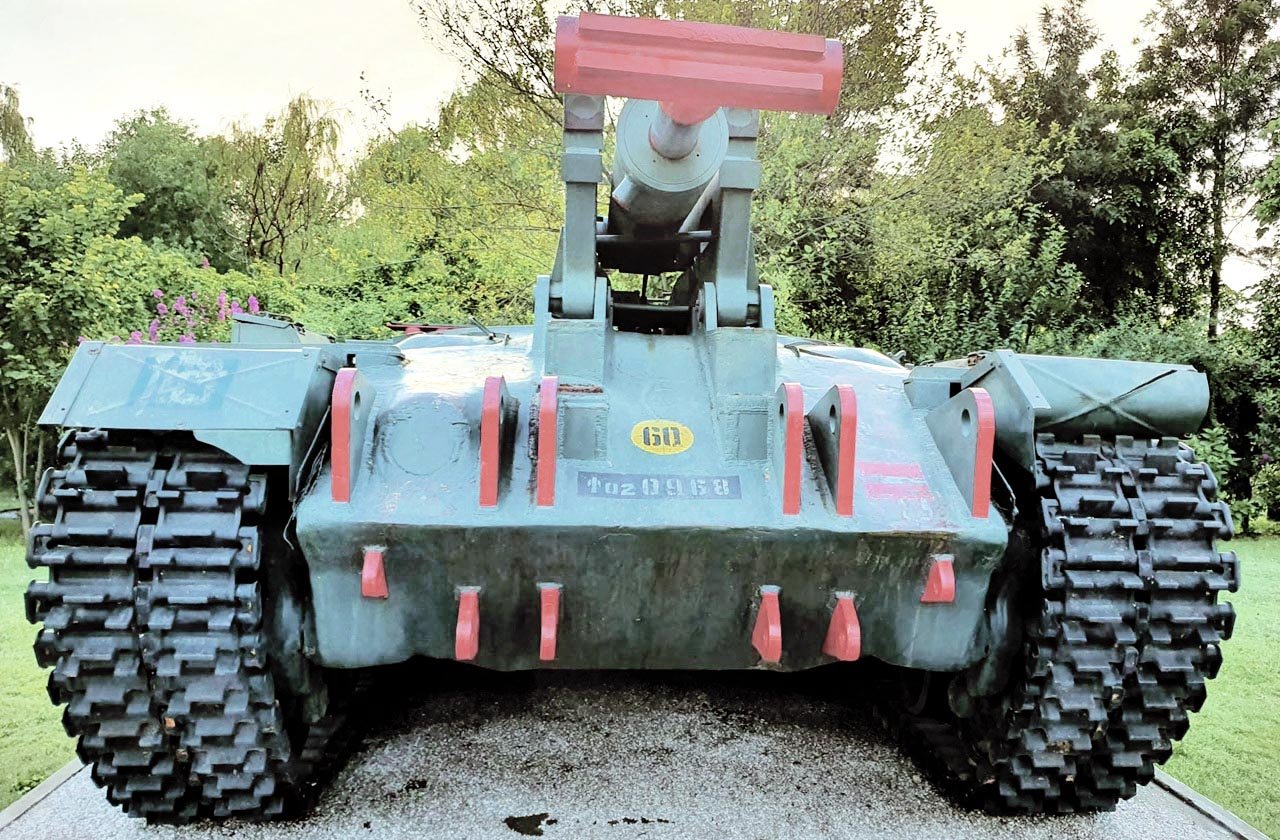
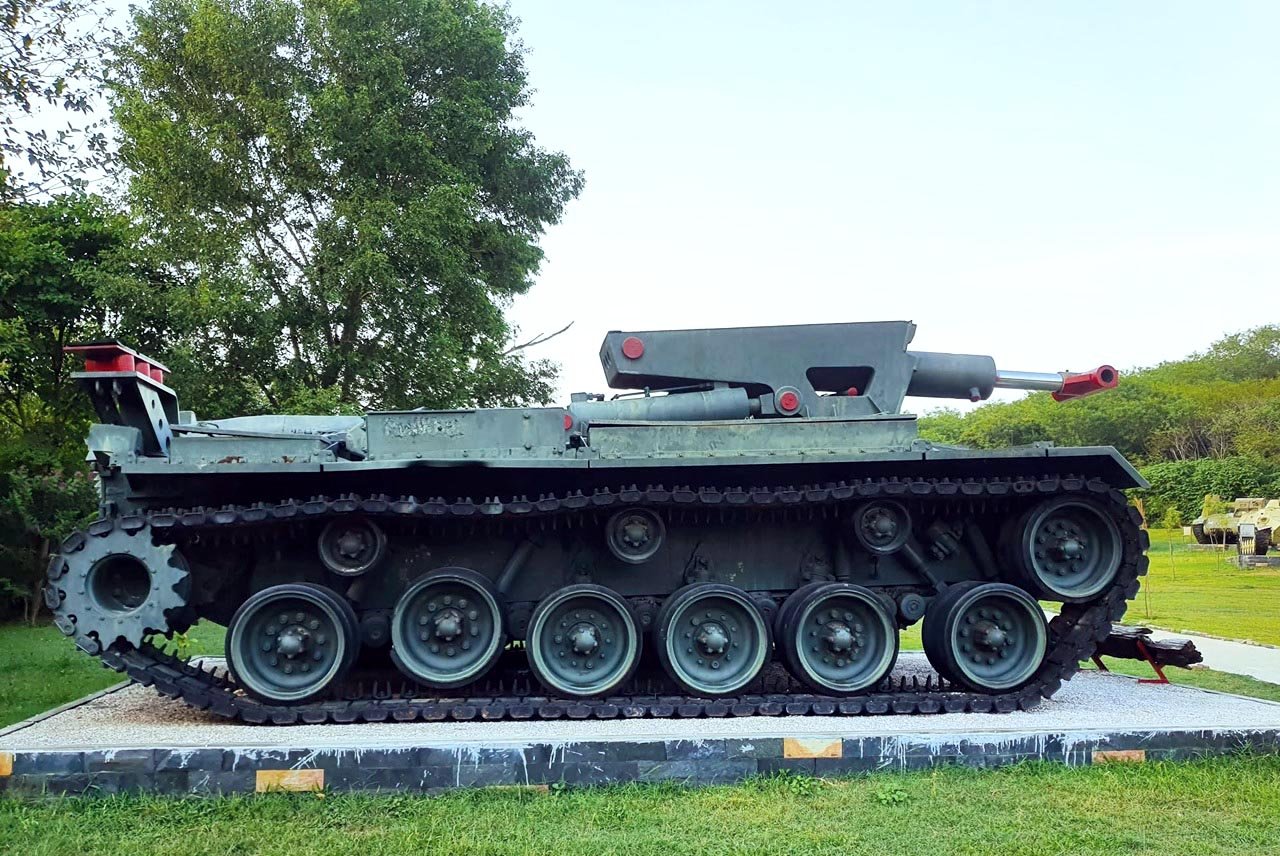
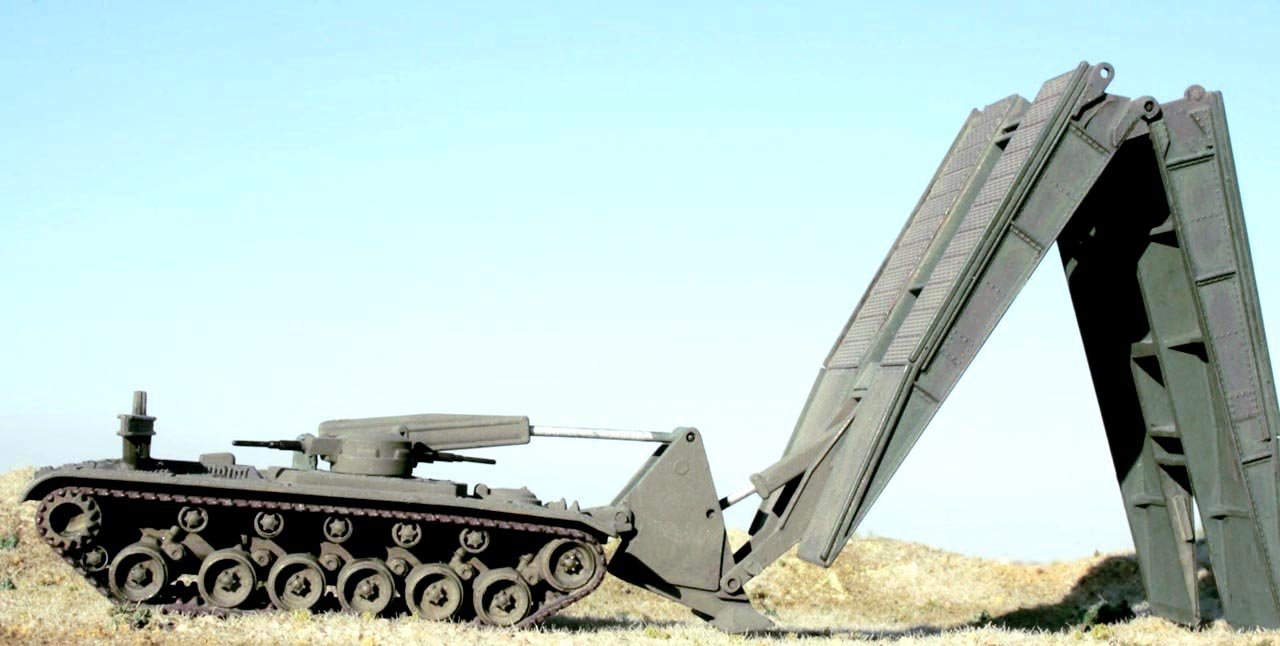
(Pakistani Army´s M-47M AVLB image, similar to the planned Spanish M-47E2 LP AVLB). In an effort to equip the Spanish Army’s engineering units with new vehicles suited to their mission, the Spanish firm Talbot S.A. initiated a series of projects in the early 1980s using the chassis of the American M-47E medium tank, which was in widespread service with the Spanish Army at that time. The Spanish M-47E medium tanks had been modernized between 1975 and 1980 and were equipped with the Continental AVDS-1790-2D diesel engine from the M-60 tank, resulting in the M-47E1 variant. This engine developed 760 hp and was coupled to an Allison CD 850-6A transmission, giving the vehicle excellent mobility. Its maximum road speed was 56 km/h (without the bridge) or 43 km/h (with the bridge) and the range was about 600 km. It could climb gradients of up to 60% (without the bridge) or 45% (with the bridge), and could cross trenches up to 2.45 meters wide. The maximum vertical obstacle that could be overcome was 0.48 meters (with the bridge) and it could ford watercourses up to 1.20 meters deep without preparation.(Pakistani Army´s M-47M AVLB image, similar to the planned Spanish M-47E2 LP AVLB). The running gear consisted of six double road wheels on each side and three double support rollers, with the idler wheel at the front and the drive wheel at the rear. The suspension consisted of torsion bars with hydraulic shock absorbers on the first, second, fifth, and sixth road wheels. The armament consisted of a 12.7mm M-2HB machine gun with 600 rounds installed on the hull’s roof and 6 smoke grenade dischargers, with a smoke-generating exhaust system (TEESS) capability for concealment. The M-47E2 LP‘s armor was the same as that of the M-47E tanks, that is, based on welded steel plates with a maximum thickness of 101mm on the front and 12.7mm on the floor.(M-47E2 LP scale model image). In the M-47E2 LP armoured vehicle-launched bridge (AVLB) the tank’s turret would be removed and two cupolas installed for the two crew members: the commander/driver and the assistant, as well as the various hydraulic systems for laying and retrieving the bridge. Both crew members were equipped with M-13 periscopes, and the commander had an AN/VVS-2 passive sight. The bridge’s operation was a mechanical-hydraulic system. At the front of the hull was a support base and an arm for securing, lifting, deploying, and retrieving the bridge, while at the rear of the hull (above the engine) was a support bracket for the bridge in its transport position. The selected bridge was the American MLC-60 scissor bridge, which allowed the passage of vehicles weighing up to 60 tons. The bridge measured 10.80 meters when folded and extended to 21.40 meters, enabling it to span gaps up to 20 meters wide. The bridge was made of aluminum and weighed 9.30 tons, with a roadway width of 4 meters. This roadway consisted of two 1.52-meter-wide lanes separated by 0.96 meters. Support was provided by tilting footings, allowing for excellent adaptation to uneven terrain and permitting a maximum gradient between the ends of -20% to +50%.