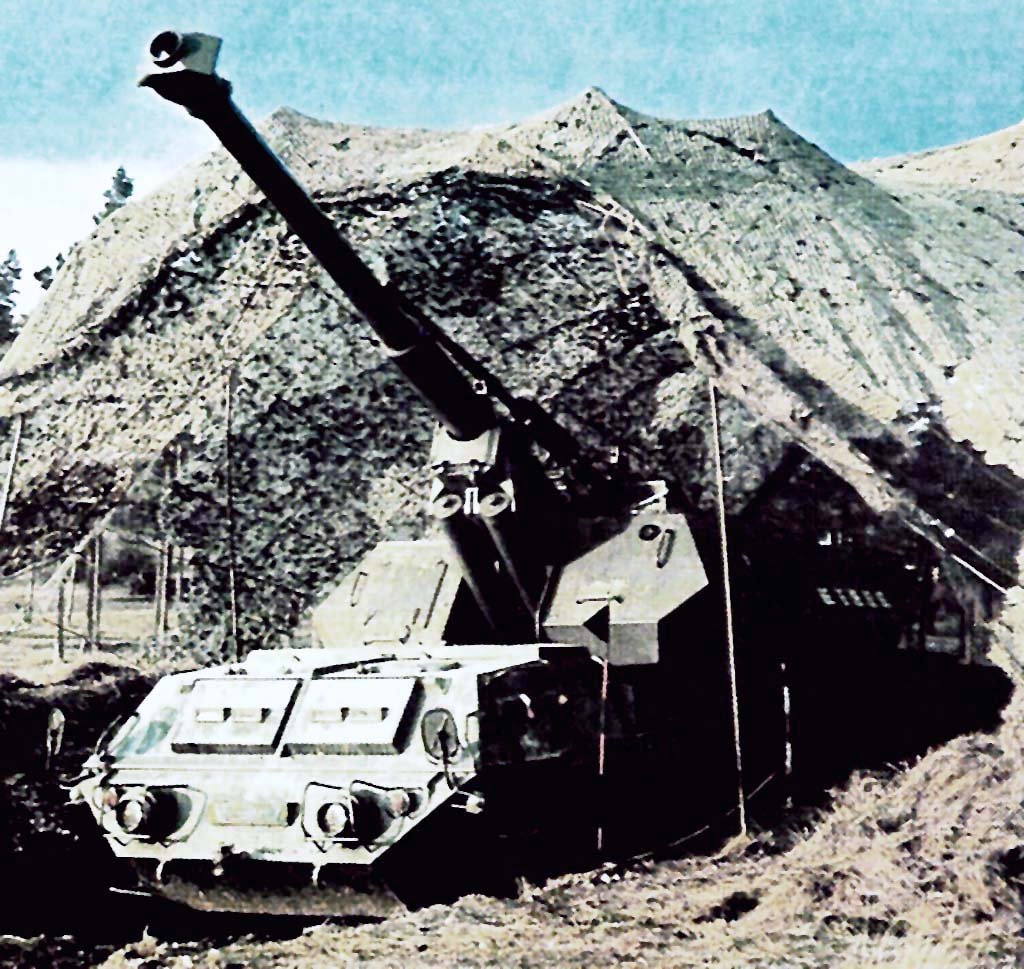
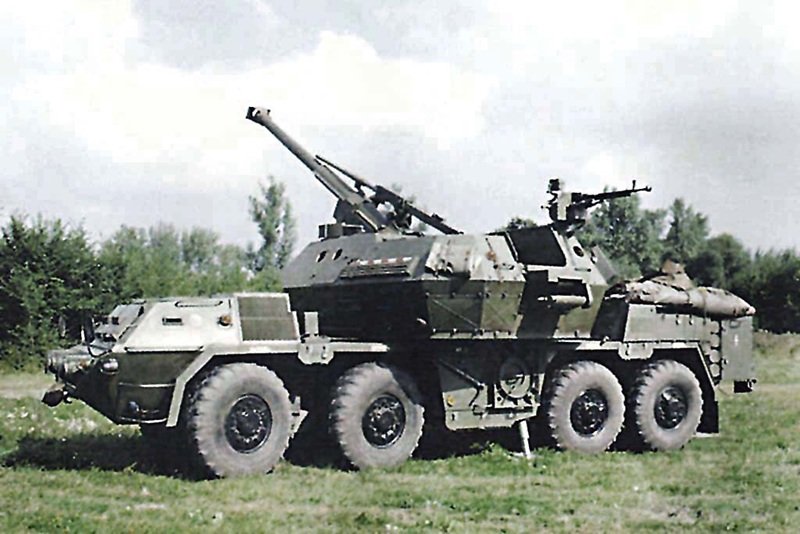
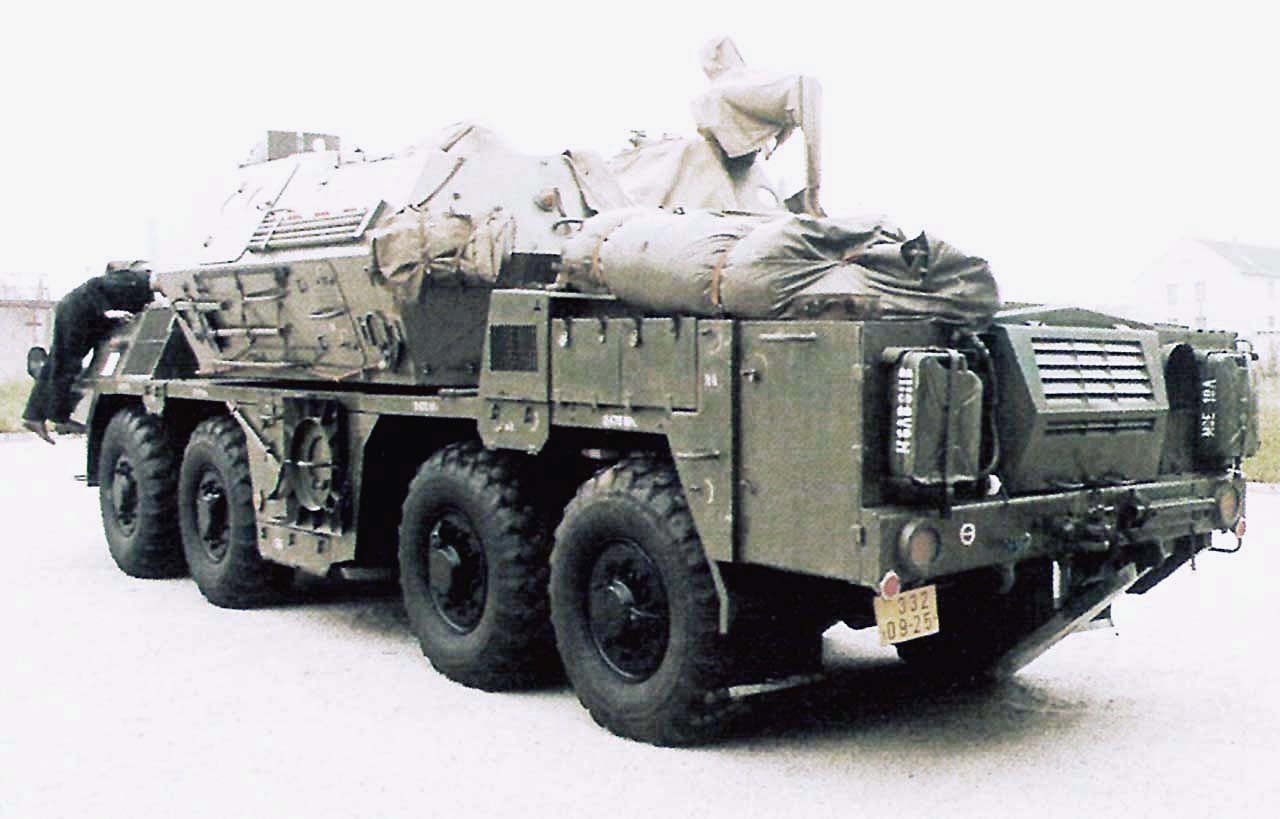
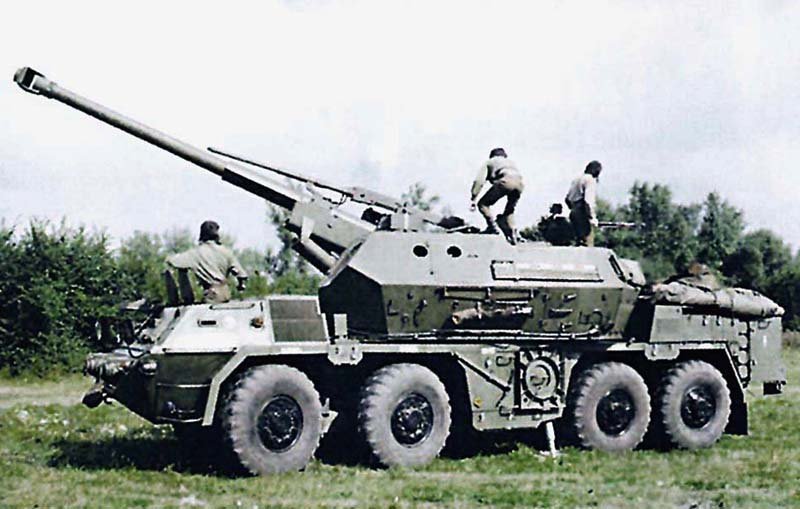
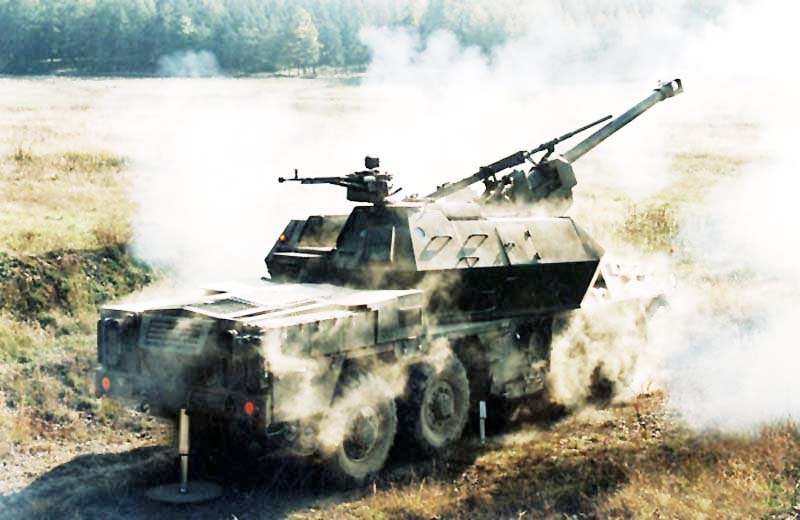
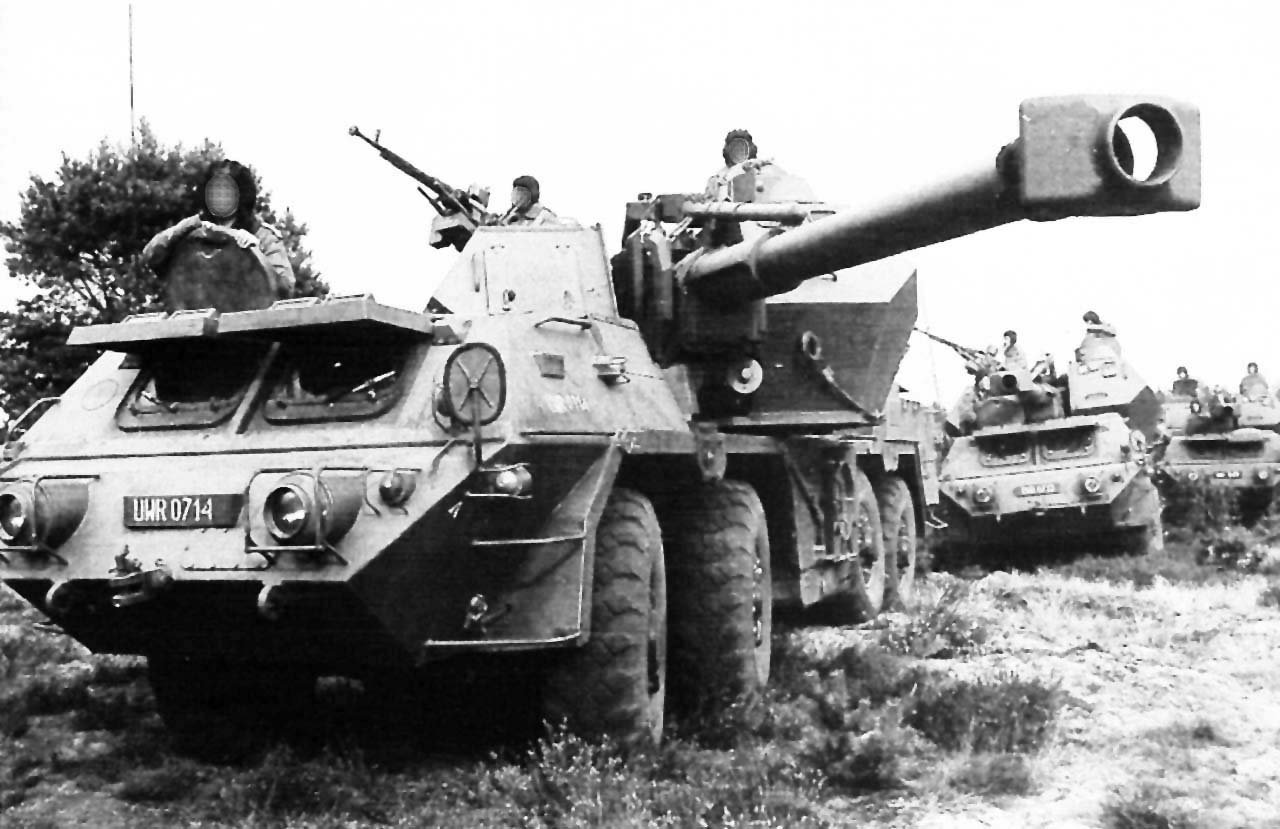
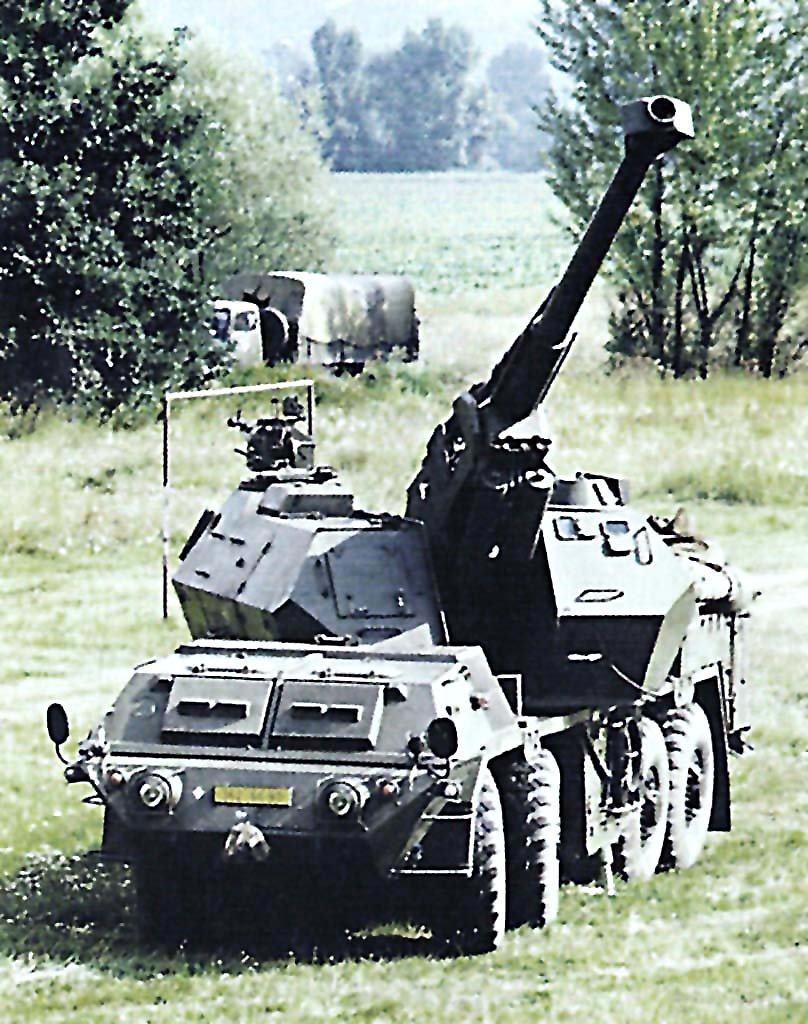
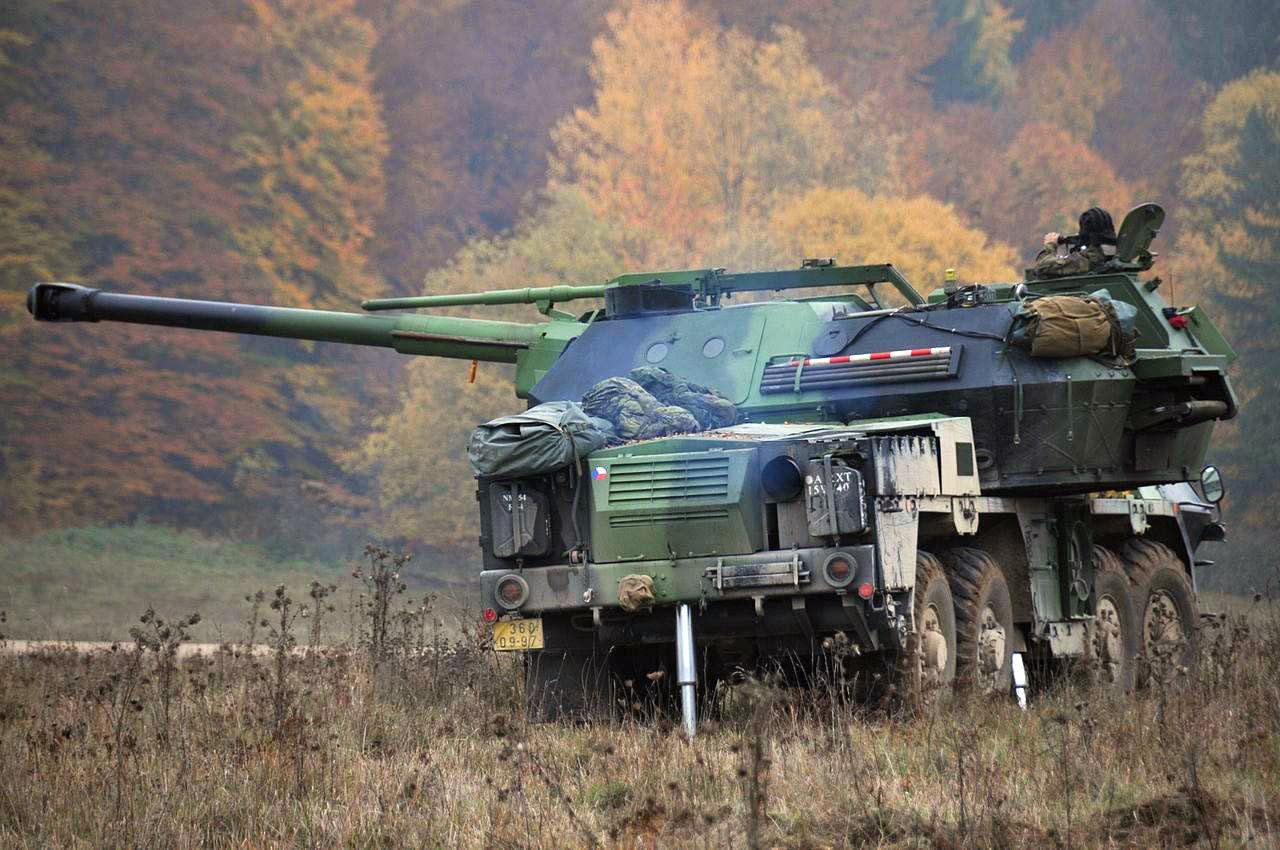
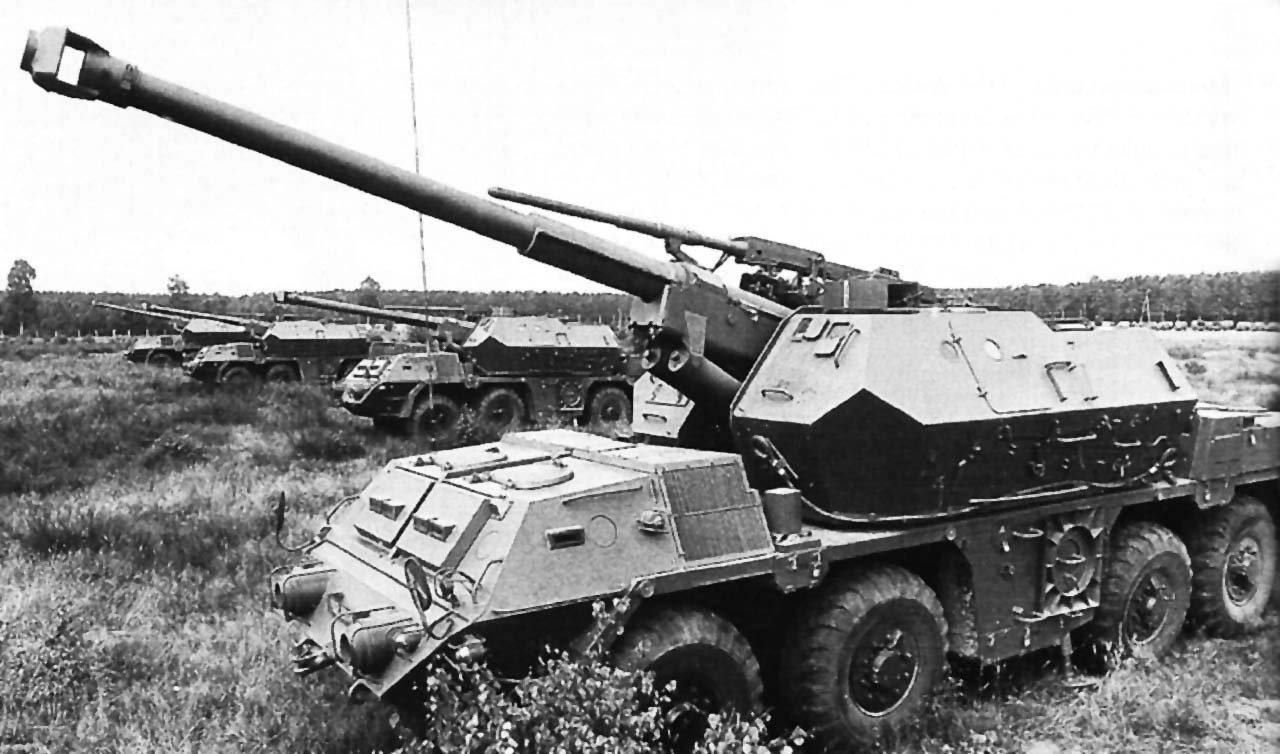
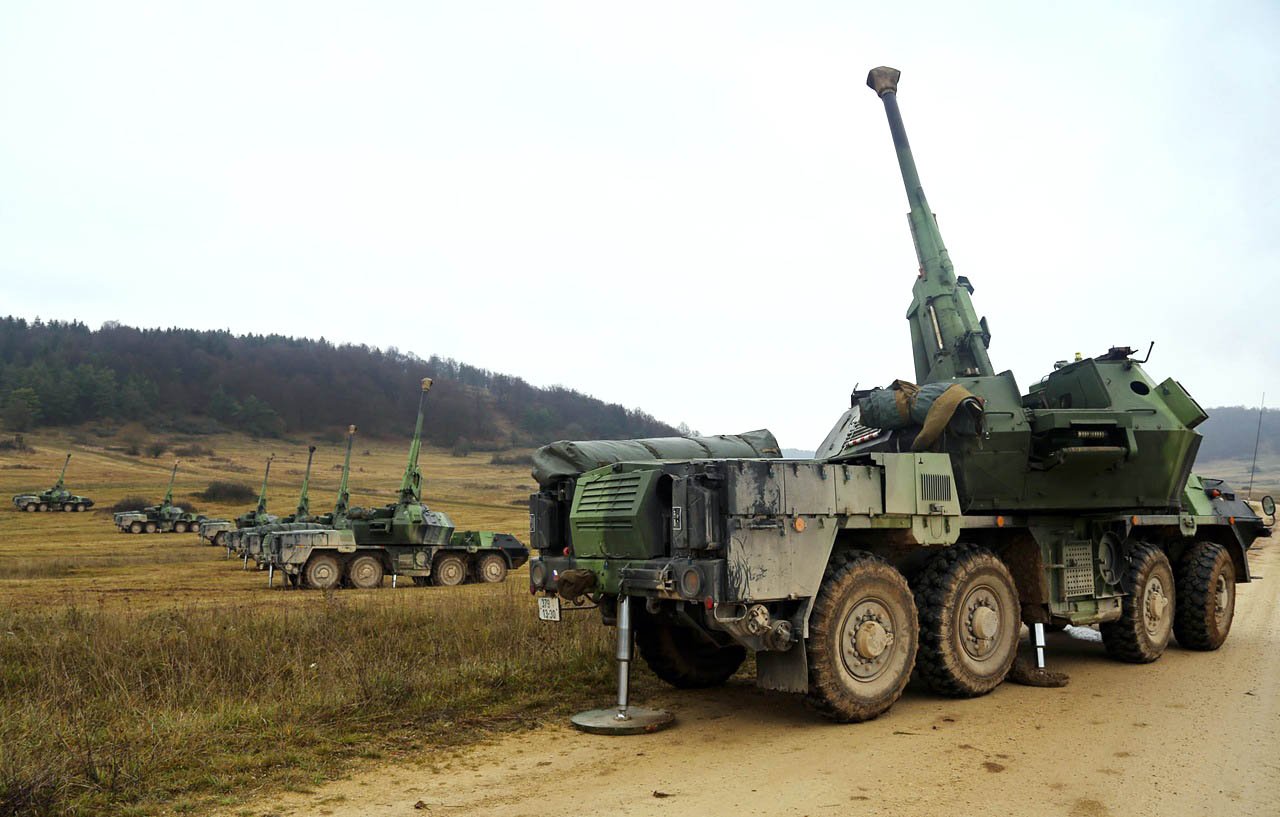
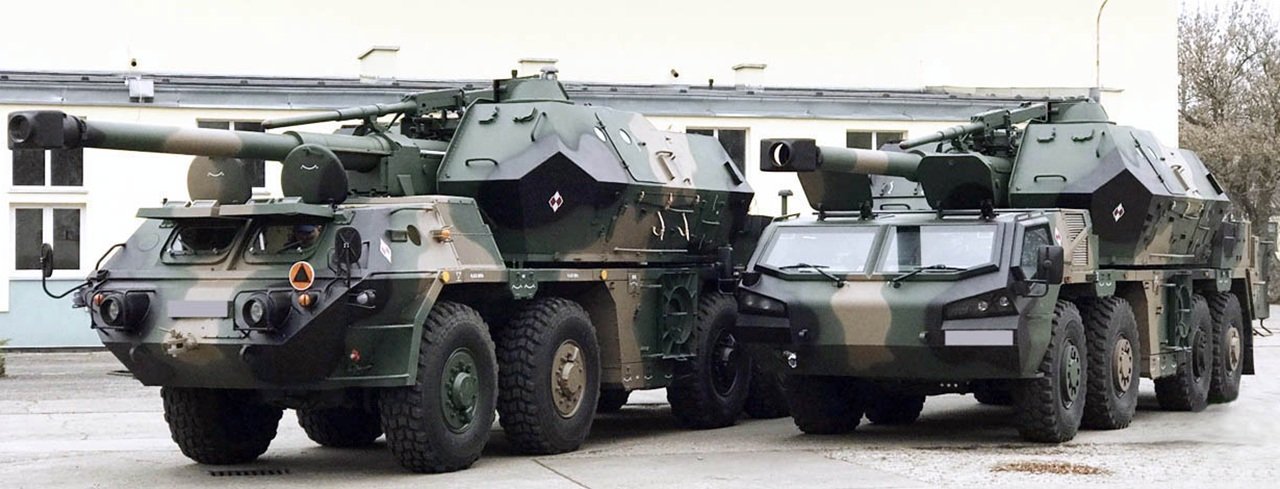
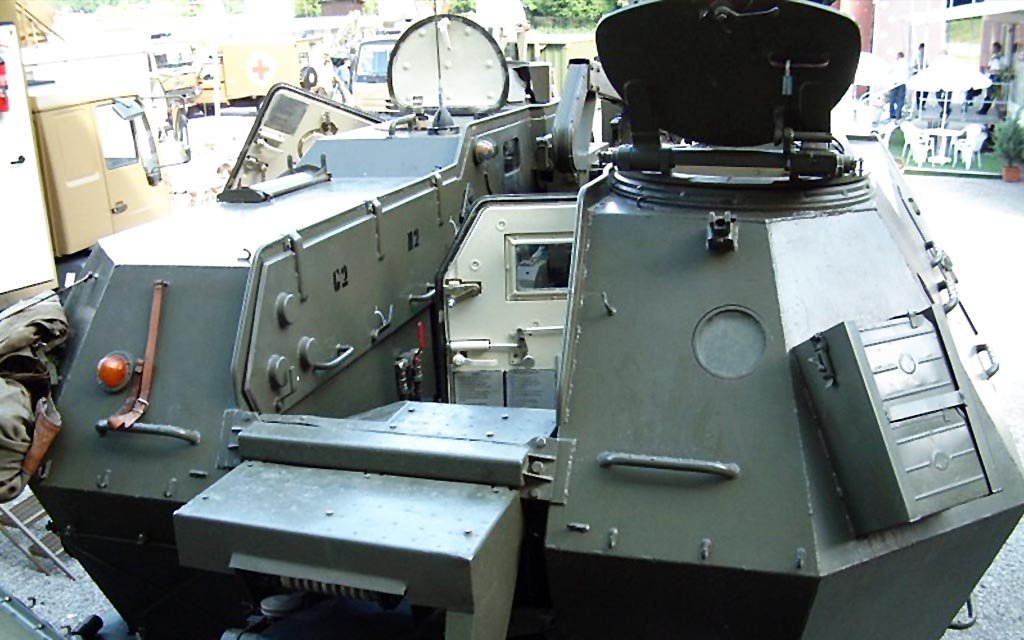
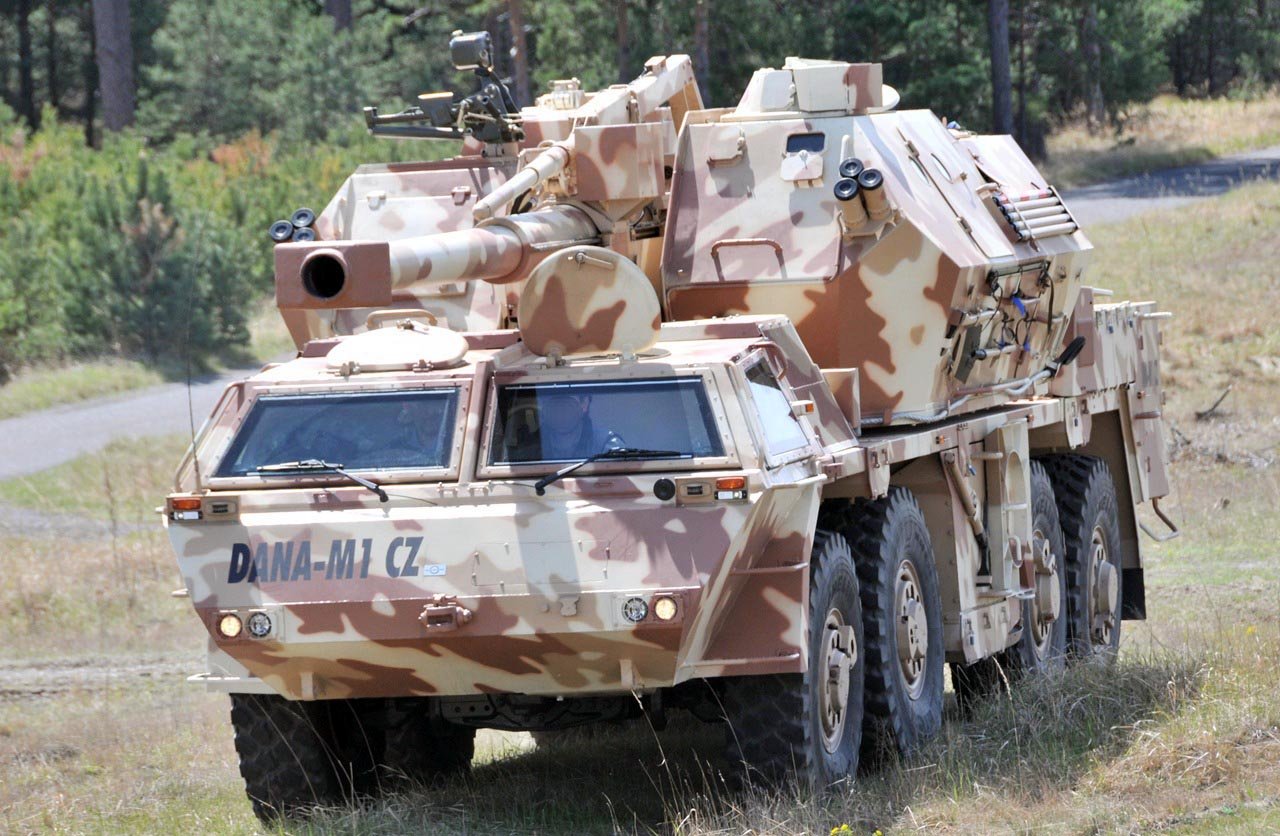
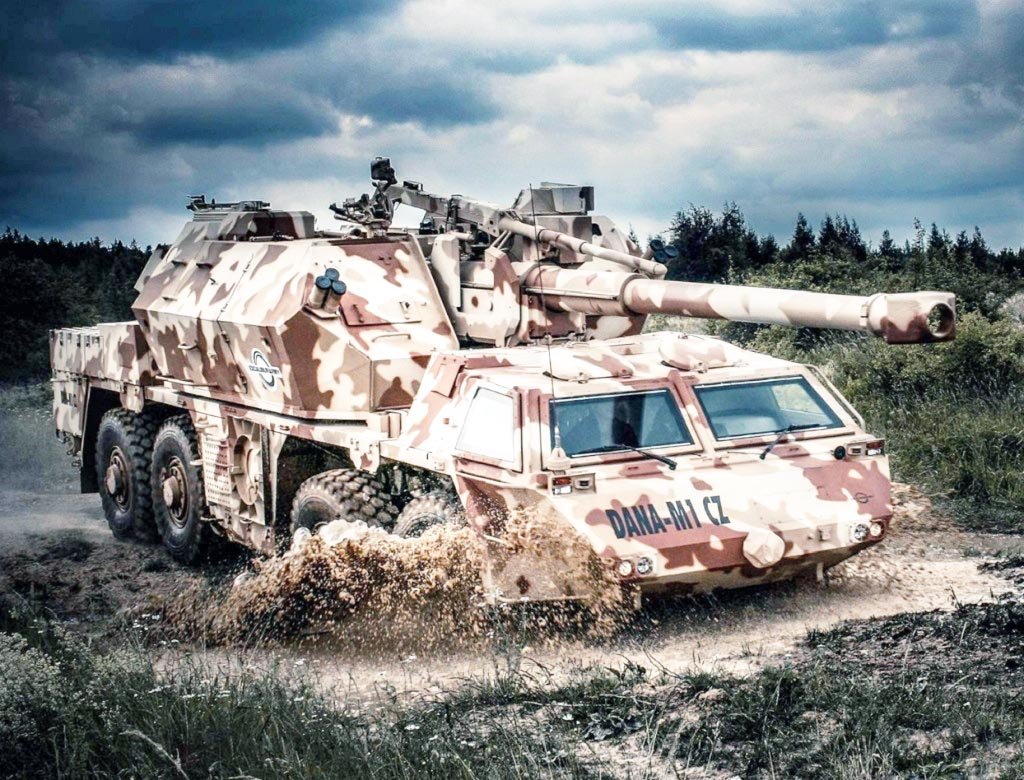
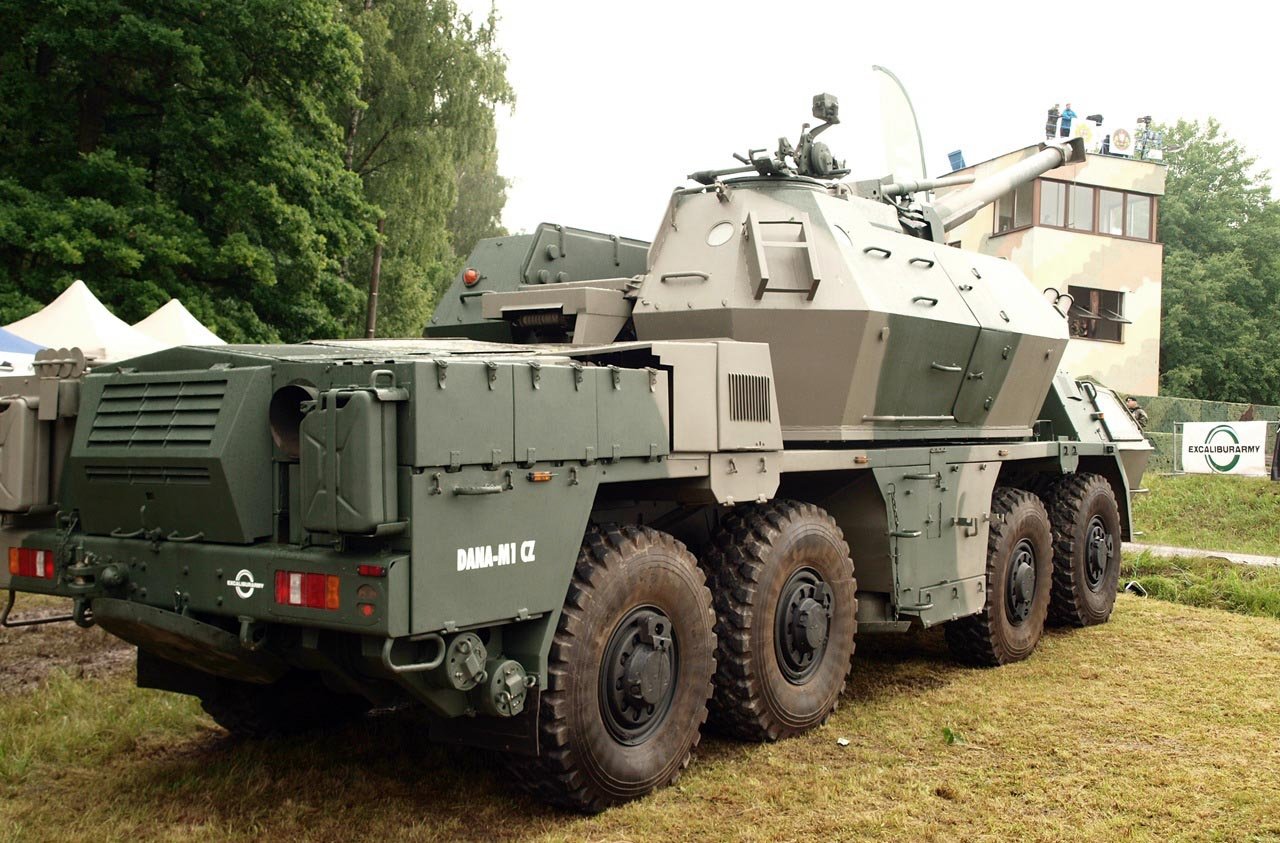
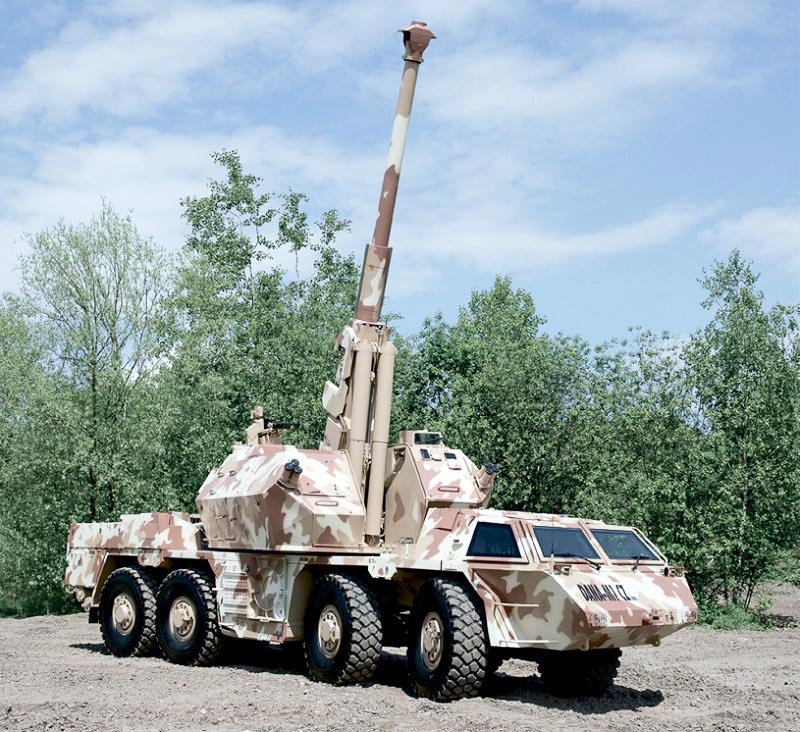
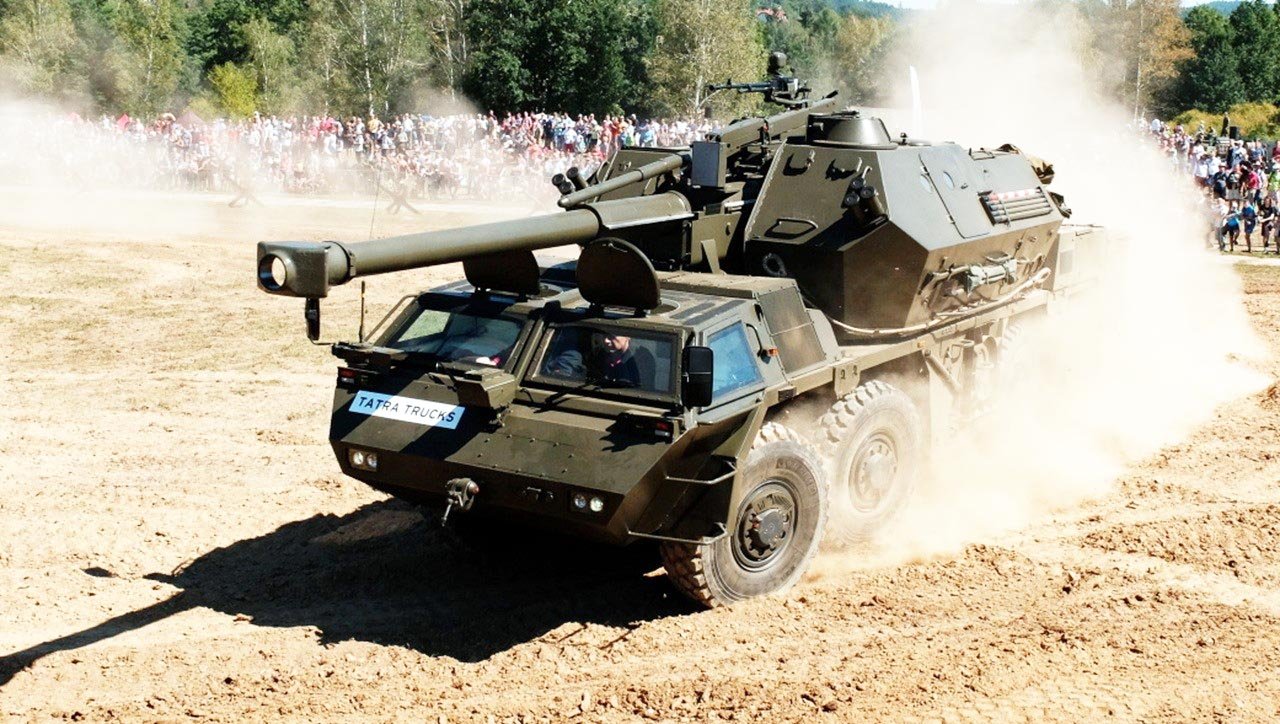
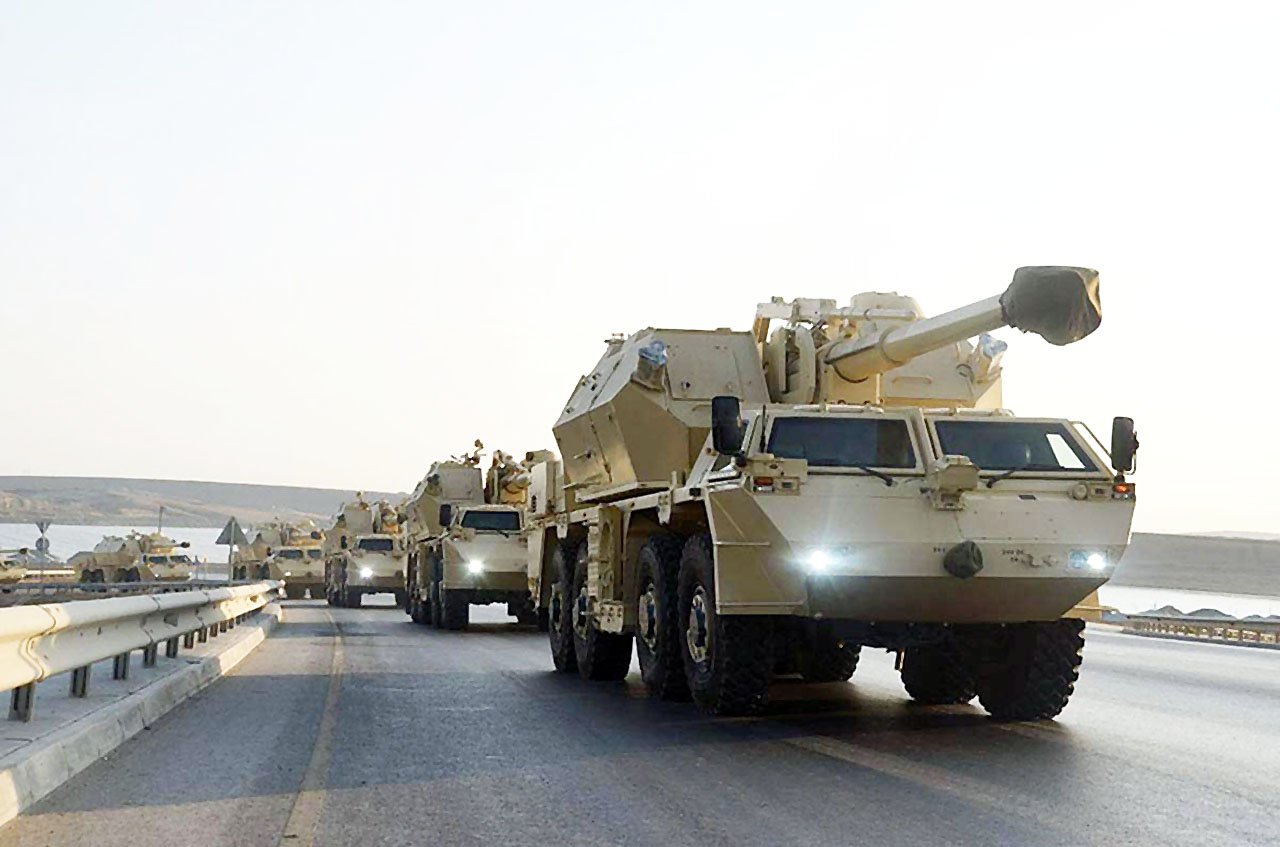
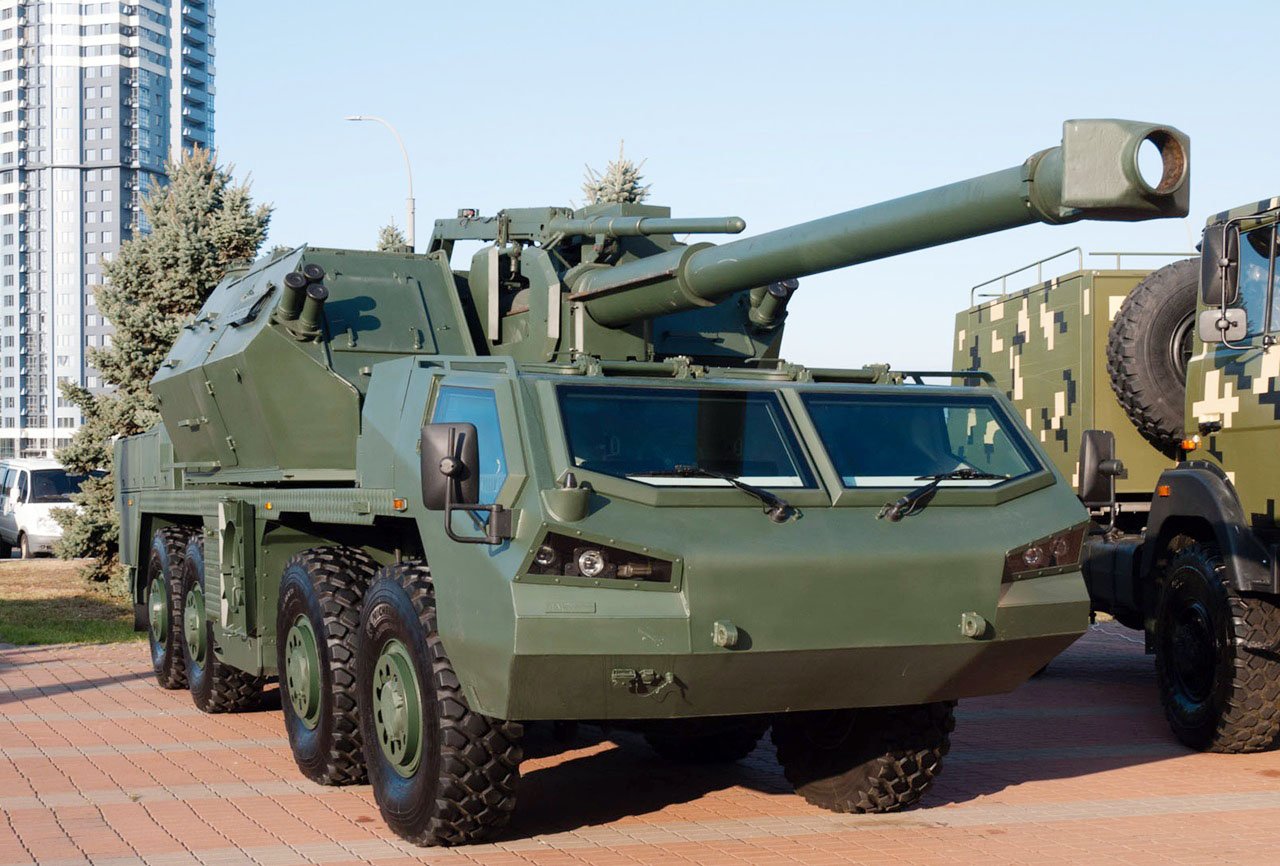
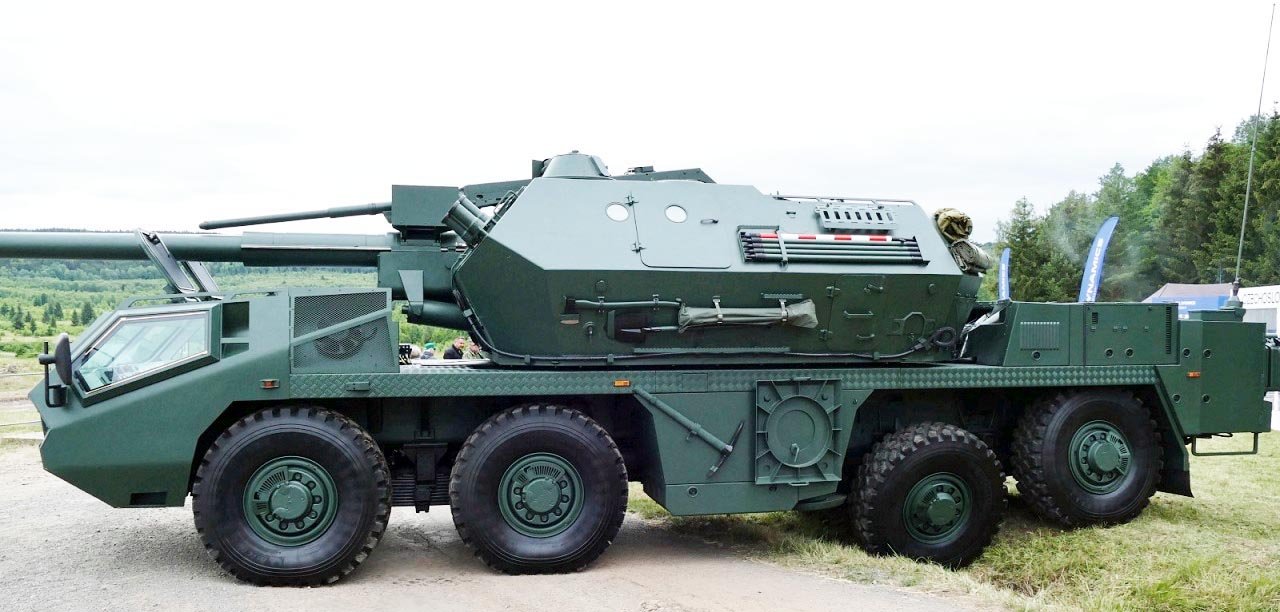
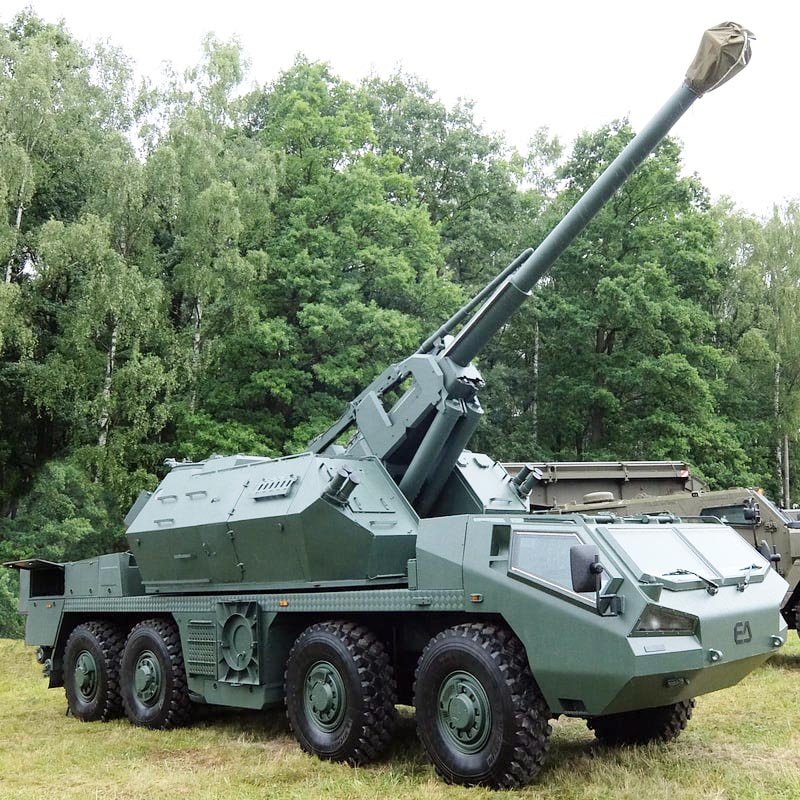
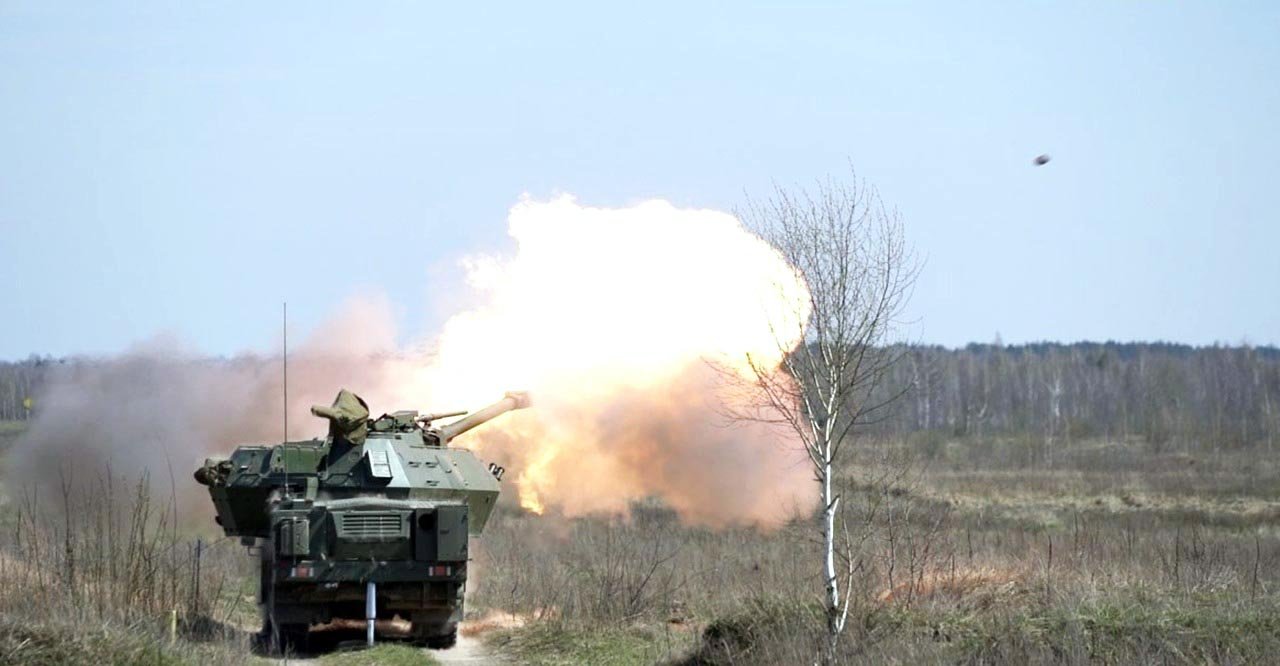
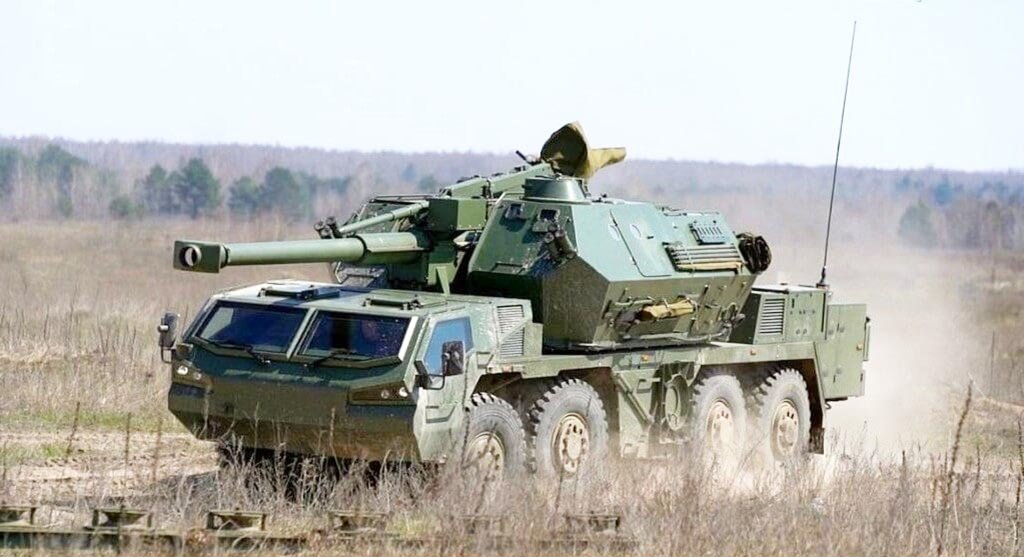
In the early 1970s, Konštrukta Trenčín began designing a new 152mm self-propelled howitzer based on the chassis of an 8×8 Tatra T-815 truck, a novel approach for this type of vehicle. The aim was to create a vehicle that was cheaper to manufacture and maintain, yet possessed good off-road capabilities and could travel faster on roads. In 1976 the design was approved and the Czechoslovak company ZTS Dubnica nad Váhom was in charge of manufacturing the “Samohybná Kanónová Húfnica vzor 77” (ShKH vz. 77) better known as DANA, which is the acronym for “Dělo Automobilní Nabíjené Automaticky” (Self-loading gun on a truck chassis).The 152mm vz.77 DANA self-propelled howitzer incorporated several unique innovations during its manufacture, such as the use of an 8×8 wheeled chassis and an automatic loading system that allows it to load projectiles at any elevation angle. The 8×8 chassis of the Tatra T-815 truck was modified to accommodate a large front-mounted crew cab, a massive turret with the armament mounted in the middle, and the power unit at the rear.This vehicle is powered by a 345 hp Tatra 2-939-34 V12 air-cooled diesel engine, giving it a top speed of 80 km/h on roads and approximately 15 km/h off-road. The range is approximately 740 km on road, significantly greater than that of most tracked vehicles of the time. The DANA‘s 8×8 configuration allows it to cross trenches up to 2.10 meters wide, climb vertical obstacles of 60cm, and cross streams up to 1.40 meters deep. It can negotiate slopes of 15% and gradients of 30%. The vehicle features power steering on the first four wheels and a central tire inflation system to adapt to the terrain and improve off-road mobility.The crew consists of 5 members: the driver/mechanic and the commander, who are located in the front cabin, and the gunner and two loaders/ammo handlers who are located inside the turret. The driver positions the vehicle for firing and operates the stabilizers, the commander selects the targets, the gunner aims and fires the howitzer and sits on the left side of the turret next to a loader who selects the appropriate amount of powder. On the right side of the turret is the other loader who selects and loads the projectiles.The vz.77 DANA is protected against small arms fire and shell splinters by steel plates with a maximum thickness of 15mm. The crew can operate safely from inside and the vehicle has an NBC (Nuclear, Bacteriologic and Chemical) protection system through air filtration and also has an air conditioning system for the turret and the cab. The chassis is equipped with three hydraulic stabilizers located on the sides and rear, which must be lowered before firing, as the powerful recoil of the howitzer prevents firing while supported only by its eight wheels. In addition, there is a small crane mounted on the roof of the turret to facilitate loading ammunition.(Polish vz.77 DANA image). The DANA’s main armament is a 152.4/37mm rifled howitzer equipped with a semi-automatic, vertically sliding wedge-type breech. The barrel has a muzzle brake, and the recoil system consists of two pneumatic return cylinders and a hydraulic buffer controlled by a plunger that limits its displacement. The ammunition carried inside the vehicle is 60 rounds, 36 of which are in the autoloader. This howitzer can fire all the ammunition of the Soviet D-20 and D-22 towed howitzers, as well as that of the Soviet 2S3 Akatsiya self-propelled howitzer. Its secondary armament consists of a 12.7mm DShKM or NSVT heavy machine gun with 2,000 rounds.The 152mm howitzer is mounted in the center of the turret and, thanks to its design, allows for wide arcs of fire. The vertical firing sector ranges from -4° to +70°, and the horizontal firing sector is achieved by rotating the turret, providing a 225° firing sector. The howitzer’s rotation system is hydraulic, although a manual system is available for emergencies. The maximum range is about 19 km, although with assisted or base bleed ammunition it reaches 25.5 km. The vz.77 DANA can fire its first shot within 2 minutes of receiving the order and can leave the firing position just 1 minute after completing its mission.DANA‘s automatic loader allows a maximum rate of fire of up to 9 rounds per minute for a short time, but the normal rate is about 4 or 5 rounds per minute in semi-automatic mode and 2 rounds per minute in manual mode. The propellant charges and projectiles are carried on opposite sides of the turret, charges on the left and rounds on the right, and the howitzer loading process is fully mechanized and allows the loading at any elevation angle.(Polish vz.77 DANA image). DANA‘s fire controls are very simple and do not allow for autonomous use; instead, they depend on other auxiliary systems that provide target information. The gunner has a ZZ-73 panoramic telescope and a PG1-MD sight for indirect fire, as well as an OP5-38-D telescopic sight for direct fire, allowing him to engage targets up to approximately 2 km away. In addition, the vehicle also features a night vision system.Originally, the vz.77 DANA artillery system had three main types of ammunition: a 43.5 kg high-explosive (HE) round called “152-EOF” with a range of 18.7 km, another HE round with an extended range of 20 km called “152-EOFd”, and another 27.4 kg round called “152-EPrSv”, which is a high-explosive anti-tank (HEAT) round suitable for attacking armored targets with direct fire. Later, other types appeared, most notably the 58.9 kg “DN1CZ Extended Range Round”, which allows targets to be reached at a distance of 25.5 km.(Polish vz.77 DANA image). Following its acceptance by the Czechoslovak People’s Army in 1977, an initial order was placed for 408 units, but production was delayed, and the first vehicles did not enter service until 1981. The DANA was also offered for export, with Poland becoming the first customer, acquiring 110. Subsequently, Libya ordered 120 units, and in 1983 the Soviet Union acquired 10 vehicles for testing. In the late 1980s, the Soviet Union placed an order for approximately 120 DANAs for use by the 211th Artillery Brigade of the Central Force Group, deployed in Czechoslovakia.The Soviet vehicles were only in service for two years, and after the collapse of the USSR, all vz.77 DANA howitzers were transferred to the Czechoslovak army. Later, when Czechoslovakia dissolved, the DANA howitzers were divided between the Czech Republic and Slovakia, receiving 270 and 135 units respectively. After a few more years of service, the Czech Army decided to dispose of 47 vehicles, which were transferred to Georgia in 2004. Recently, in 2022, the Czech Republic donated an unknown number of these vehicles to Ukraine. Production of the vz.77 DANA was maintained between 1979 and 1994, with around 770 vehicles being built.(Ukranian vz.77 DANA image). The first vz.77 DANA self-propelled howitzers used in combat were those of the Polish army, which were deployed in Afghanistan. At least five of them are known to have been used in Ghazni Province in 2008. Georgian vz.77 DANAs saw combat against Russian forces during the 2008 Russo-Georgian War, where some were destroyed and three or four were captured. And Ukraine is using them against the Russians in the 2022 Russian invasion of Ukraine.Currently, the vz.77 DANA can be considered outdated compared to the Swedish Archer, the French Caesar, or the Serbian B-52 Nora, among others. However, in the late 1980s, the manufacturer presented a prototype called “ONDAVA” (on the image), which featured a new 152.4/47mm howitzer instead of the original 152.4/37mm, a new 355 hp Tatra T3-930-52 diesel engine and a crew of only four members. The new howitzer achieved a range of over 30 km and a high rate of fire at 6 rpm, although ammunition storage was reduced to 40 rounds. The ONDAVA did not progress beyond the prototype stage and was not mass-produced.(Polish vz.77 DANA & DANA-M image). Following the dissolution of Czechoslovakia, both the Czech Republic, through the Excalibur Army company, and Slovakia, through the firm ZTS Dubnica nad Váhom, developed different variants of the vz.77 DANA armed with 152mm and 155mm howitzers. Slovakia has presented the MODAN (152mm prototype), ZUZANA (155mm), A-40 HIMALAYA (155mm prototype on a T-72 MBT chassis), and ZUZANA 2 (155mm) systems. The Czech Republic has developed the DANA M1 (152mm), DANA M2 (152mm), DITA (155mm), and MORANA (155mm prototype) systems.In 1999, the Slovak company ZTS Dubnica nad Váhom presented a modernized vehicle designated “vz.77/99 MODAN” (on the image), armed with a new 152.4/42mm howitzer and a digital fire control system. This prototype used the same engine as the earlier ONDAVA prototype, had a rate of fire of 5 rpm, and a 60-round ammunition capacity. The crew consisted of four members, eliminating the need for a second loader thanks to the new digital fire control system. According to some sources, the Slovak Army may have modified up to eight vz.77 DANA vehicles between 1999 and 2004.In 2011, the Czech firm Excalibur Army unveiled a new variant of the DANA, designated DANA M1 CZ (on the image). This new vehicle features a redesigned exterior, incorporates a series of digital systems that enhance its artillery capabilities, and includes improvements to the cabin, chassis and engine. Among its new features was a high-performance fire control system (FCS) designed for integration into the C4I system. This system comprises a gun commander’s ballistic computer and smart terminal, a new communication system, and an inertial topographic navigation unit.(DANA M1 CZ image). The inertial topographic navigation unit is mechanically attached to the barrel axis and continuously transmits real-time data on position, elevation, and traverse angles to the ballistic computer. The ballistic computer then generates fire missions, incorporating its own topographic data, target identification data, and ammunition selection. After analyzing the provided data, the system outputs the coordinates and information needed to engage the target.(DANA M1 CZ image). DANA M1 CZ cab has been modified to improve the driver’s field of vision, and a new instrument panel has been installed, including a monitor for the reverse gear camera. A new air conditioning system, new seats, and a new lighting system, including a “blackout” mode for night driving, have also been installed. A new TATRA-NORGREN shift-by-wire steering system has been fitted for easier driving, and the new 355hp Tatra T3-930-52M V12 air-cooled diesel engine features a new intercooler and new turbochargers that have improved the power curve, the torque and the off-road speed, that has increased from 15 to 25 km/h. Road range has decreased from 740 to 600 km, but it remains remarkable.The 152.4/37mm howitzer installed on the DANA M1 CZ has similar performance to that of the vz.77 DANA, with a maximum range of approximately 19 km with standard ammunition or 25.5 km with base bleed ammunition. The rate of fire is also the same: 4 or 5 rounds per minute in semi-automatic mode and 2 rounds per minute in manual mode. The ammunition carried on the vehicle is also similar: 60 rounds, 36 of which are in the autoloader. The secondary armament consists of a 12.7mm NSV machine gun.Despite all the innovations included in DANA M1 CZ, it has not been very successful in the market, and only Azerbaijan placed an order for 36 modified vehicles designated as DANA M1M (on the image), which were delivered between 2017 and 2018. This transaction sparked enormous controversy because, as denounced in 2019 by the International Vigilance Committee (IVC), the Czechoslovak Group holding company, which owns the companies that manufacture the DANA M1M howitzer, violated the arms embargo imposed on Azerbaijan.(Azerbaijani DANA M1M image). The embargo was established in 1992 by the Organization for Security and Co-operation in Europe (OSCE) and subsequently by the United Nations due to the war with Armenia over the disputed territory of Nagorno-Karabakh. In 2002, the United Nations lifted the embargo, but the OSCE, of which the Czech Republic is a member, did not. Therefore, in 2017-18, the embargo remained in effect. The Czechoslovak Group holding company did have permission from the Czech government to sell 54 Tatra 815 trucks to Azerbaijan, but the permit did not include DANA M1M howitzers or Vampire RM-70 multiple rocket launchers.(Azerbaijani DANA M1M image). The IVC organization states that a complex system was established whereby 54 Tatra 815 trucks were ultimately transformed into 36 Dana M1M howitzers and 18 Vampire RM-70 multiple rocket launchers, which ended up in the hands of the Azerbaijani Army. In summary, the trucks’ journey to becoming combat vehicles was as follows: Brno, (Czech Republic) – Tel Aviv, (Israel) – Bratislava, (Slovakia) – Tel Aviv, (Israel) – Baku, (Azerbaijan). Israel’s role in this scheme was to act as an intermediary, preventing the direct shipment of equipment from Czechoslovak Group Holding to Azerbaijan. Israel was also involved in the installation of some minor equipment on the vehicles by the company Elbit Systems.In 2018, the DANA M2 self-propelled howitzer (on the image) was unveiled, the latest addition to the 152mm DANA family. This new vehicle retains the same powertrain as the DANA M1 but with some improvements. The maximum road speed has increased to 90 km/h, while maintaining the same 600 km range and ts off-road capability. The engine has been overhauled, and a new clutch, power steering with servo assist, and a self-diagnostic system have been added. The Tatra Norgren semi-automatic transmission has also been improved, and the activation and retraction of the hydraulic stabilizers are now 65% faster.In the new M2 variant (on the image), an auxiliary power unit (APU) has been installed, which includes a hydraulic pump that allows the use of the weapon and the recharging of the batteries in case of the main engine stopping. The cabin protection has been reinforced in accordance with STANAG 4569 Level I, and an NBC protection system using air filtration has been installed. A new heating and air conditioning system has also been installed for greater crew comfort.The main improvement included in the DANA M2 (on the image) has been the installation of an advanced Onboard Control System equipped with a variety of subsystems as: ammunition selection, navigation, shooting calculation, automatic gun aiming and diagnostics. The new controls have been arranged more ergonomically for the driver and commander, allowing control of the howitzer via a touchscreen. In addition, a system called ASAP (Automatic Setting of Action Position) has been installed, which includes a complete ammunition control system that speeds up firing operations and improves the weapon’s effectiveness.(DANA M2 image). The new electronics improve the speed of entry and exit from the firing position of the vehicle, as well as increasing accuracy of the weapon, which is the same 152.4/37mm howitzer as DANA M1 variant. Therefore, the artillery qualities are the same as in the previous variant with respect to range and rate of fire, although the ammunition carried has been reduced to 40 rounds, 36 of which are carried in the autoloader. The secondary armament consists of a 12.7mm NSVT machine gun.(DANA M2 image). It seems that luck hasn’t been on this new model’s side either, with only Poland and Ukraine having acquired it so far. Poland has reportedly upgraded three of its vz.77 DANAs to the M2 variant in the period 2019-2021, designated them as “DANA-M”, but plans to upgrade more vehicles have stalled. In 2021, Ukraine expressed interest in acquiring 66 vehicles, but the number was ultimately reduced to 26, which were delivered in 2024. Additionally, Ukraine reportedly received some more DANA M2s donated by the Czech Republic in 2022 as part of the military aid program following the 2022 Russian invasion.